Some of my earliest memories include crawling around the practice putting greens at Seneca Falls Country Club in Upstate New York. I loved the feel of those putting greens. Smooth and cool to the touch. I’d roll golf balls into the cups to hear that satisfying ‘plop’ sound.
My parents, Stewart and Emily Cudworth, loved golfing, and my father once planted a grove of pine saplings that came to be named after him at that golf course. We moved near to the Meadia Heights Country Club in Lancaster, Pennsylvania, when I was five years old. Our family could never afford to be members there, but we had an associate membership to swim in the pool. That was good enough for me.
Yet my parents kept taking us to local public courses. We practiced golf shots in the flat side yard that was once a tennis court, and the Meadia Heights driving range wasn’t even a block away between two neighbors’ houses. That gave us free access to chip and drive range balls back toward the practice tee.
On rainy days, I’d grab a three-wood, 7-iron, and putter, some tees, and three golf balls to play the holes farthest from the Meadia Heights clubhouse. While I could possibly have been struck dead by lightning while golfing in the rain, a lightning bolt would have had to keep up with me, because I wasted no time teeing up, running from shot to shot, and putting out each hole.
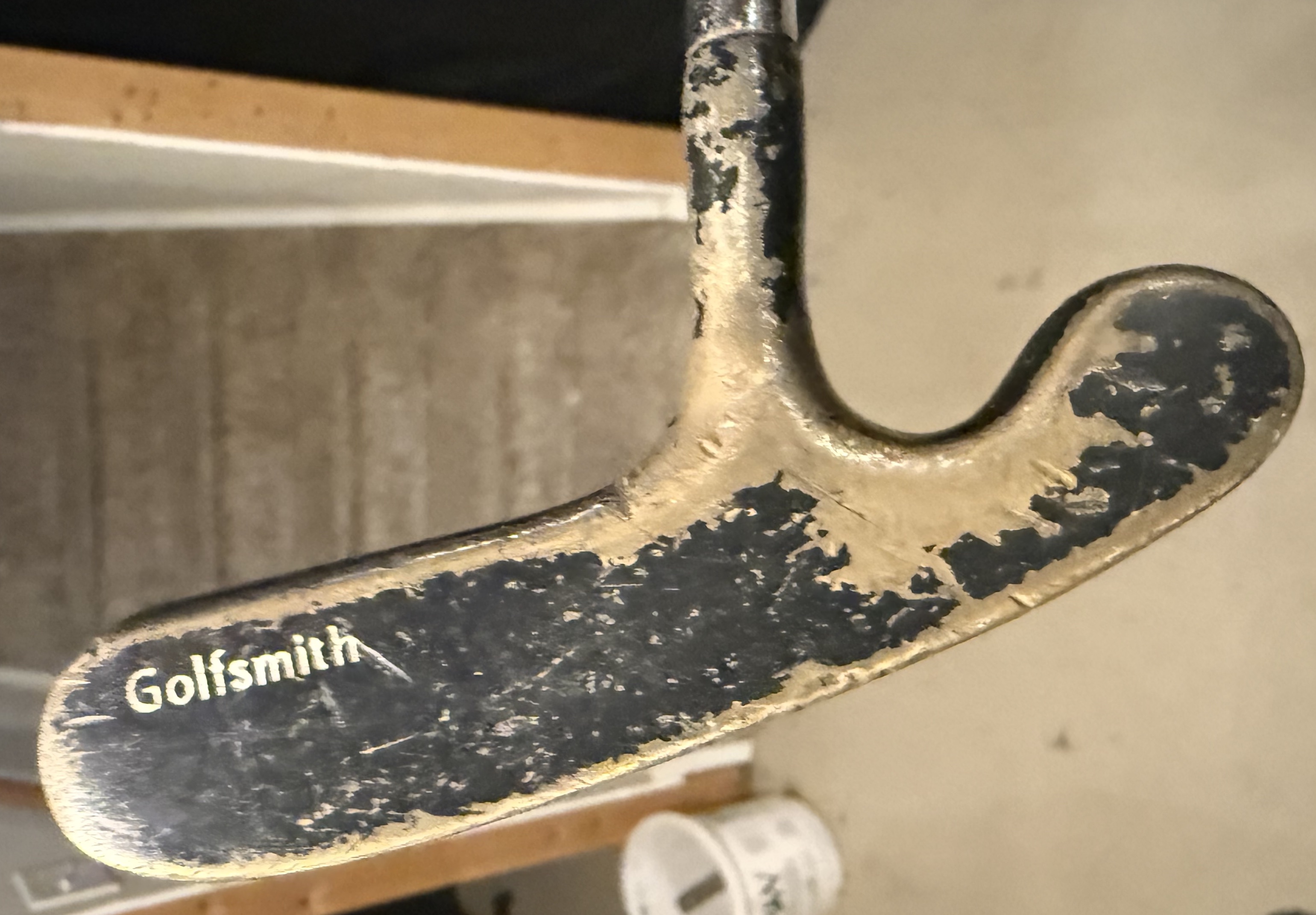
Memories of those solo rounds stuck with me over the years, as I treated that country club like it was my private course. By the time I was in my teens, I played golf with friends, sometimes spending the entire day on the course playing 36 holes or more. My father built a hobby business around building golf clubs. He made me a set of clubs using Golfsmith supplies. In the early 2000s, I won a set of newer clubs during a golf outing, but I kept the Golfsmith putter because it had sentimental value to me.
Sadly, my father had a devastating stroke in 2003 that disabled his entire right side. His golfing career was over except for riding around his favorite public course with the club pro, who appreciated my father’s love for the game.
I don’t know how many rounds I’ve played using that Golfsmith putter, but the wear on its neck testifies to how many times I’ve shoved it back in the bag and used it to finish every hole. It’s an ancient putter by modern technology standards, and I’ll confess that while playing rounds using top-level Callaway rental clubs at Florida’s Southern Hills course while visiting my brother-in-law that the high-tech putter in that set feels pretty damned good in my hands.
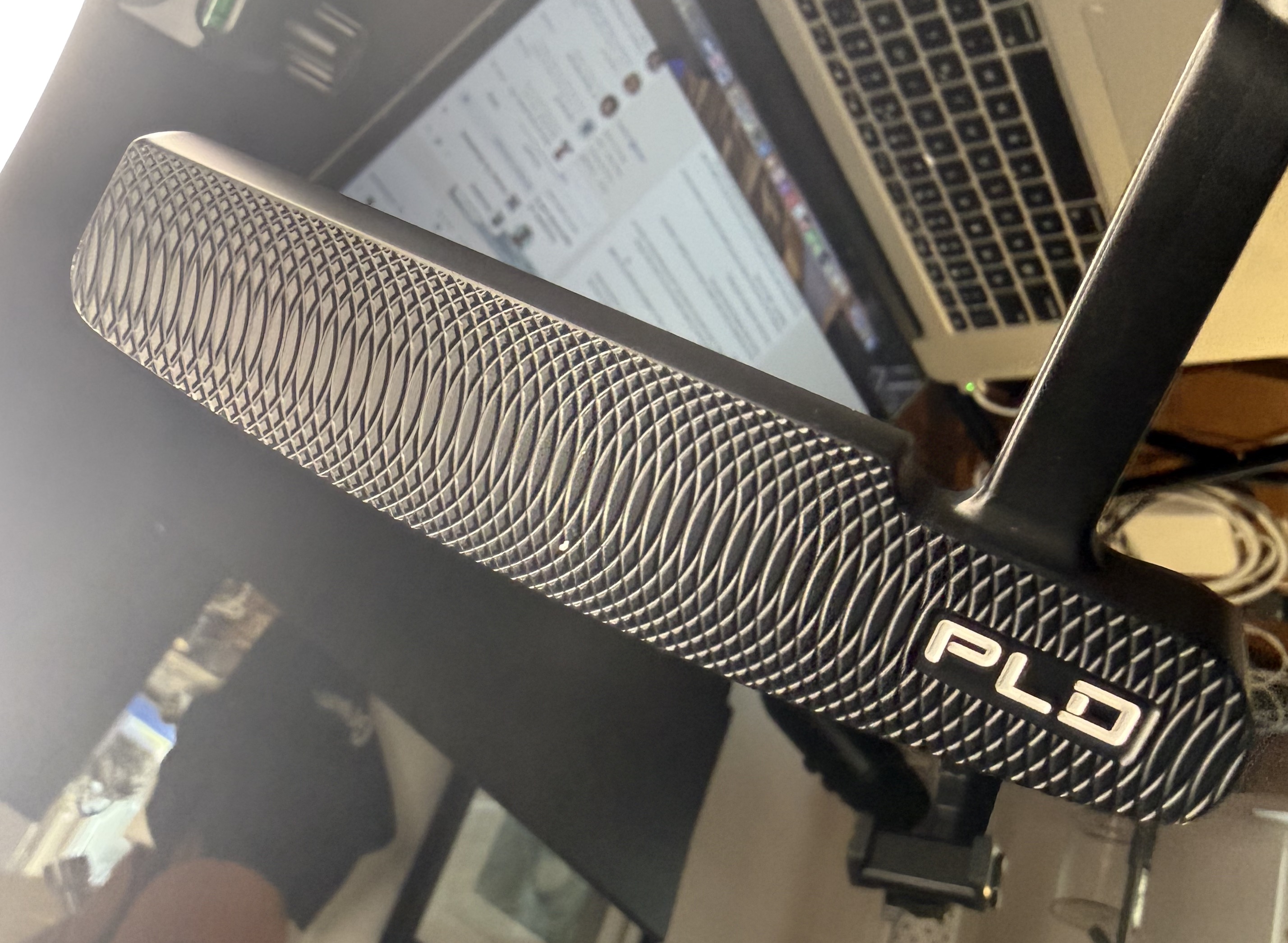
Up till now, I hadn’t thought about quitting the Golfsmith putter. But my stepchildren bought me a new Ping putter for Christmas. I happened to purchase a practice golf mat for my stepson, and we took turns using the new Ping putter. It has a sure feel, and I’m sinking lots of 10-foot putts.
I’m not a Luddite when it comes to advanced golf technology or using newer equipment. I love my big old driver head even though I don’t care for John Daly, the player who endorsed the club. I’ve also actively embraced metal woods, and my two “rescue clubs” make a positive difference in my game. While newer clubs offer a steadier, more predictable shotmaking experience, you still have to swing the clubs. I don’t believe that the clubs make the golfer. It’s rather the other way around .
The last round I shot before winter saw a legitimate 83 on the scorecard. That’s about as good as I get. I’m happy enough to get out golfing, and perhaps I’ll work at it a little more, but maybe not.
I know that my father would appreciate the new Ping in my golf bag. There’s no real use lingering in the past when there’s fun to be had trying new things. It takes the Right Kind of Pride to be willing to change.
A pensive moment at 18 years old during a college field trip
Perhaps it’s been native anxiety that vexed me in life. I’m a nail-biting kid who grew into a nail-biting adult. The roots of anxiety are chemical but also familial and cultural. Raised in a family with three other brothers, a pushy father, and an enabling mother rife with her own fears (projected upon us) it’s no wonder my life bears marks of self-confidence failures.
That said, there was no more competitive kid than me. I compensated for anxiety by trying to win everything in sight. Sports was also a release for the high-energy needs of a kid with ADHD. But I never rationally understood that condition as a child. I knew that any boring subject turned me into a lost soul staring out the window during class. Or else I drew. Art was something I could turn that attention-deficit focus into something real. Later on, I found writing too. Those three pursuits are my life’s salvation. They fueled whatever self-confidence I could muster through those elementary school years through college.
I once had a 3rd-grade teacher who gave me a choice. “Chris, you can stay inside and work on the classroom play or go out for recess. Which do you want to do?”
Well, I was leading the kickball home-run contest during recess. It made me the hero of the whole school. But she didn’t ask me about that. I told her, “I want to go out to recess.”
“Fine,” she blurted. “You don’t get to do either. You can sit here with your head down the whole period.” That’s what she made me do. She punished me for a choice I had sound reasons to make.
But in 4th grade, I had a teacher whose Robert’s English Series curriculum combined writing, art, and plays. I thrived in that class and wrote about it once on this blog or another. One day I received a phone call from National Public Radio. A reporter conducted a Lexis-Nexus search about that curriculum and my writing was the only article that turned up. They interviewed me about it. It made me feel good to be recognized for appreciating the value of integrated education. It bolstered my self-confidence to hear that someone else understood the value of helping kids, especially neurodivergent kids like me, find self-confidence through innovative teaching.
These days, I substitute teach and notice many kids struggling with classroom attention. Perhaps I should have chosen teaching as a profession, but I’m not sure I had the self-confidence or self-assurance earlier in life to do so. It takes enormous focus for effective classroom management. I might have been too forgiving or unwilling to discipline kids acting badly.
Part of me also resists those tactics because our elementary schools in Pennsylvania used corporal punishment to control kids. In first grade, I shoved a kid for knocking over a Stratego game we were playing during indoor recess due to a rainy day. The kid tattled on me and instantly a vicious old lady teacher named Mrs. Paloney entered the room, grabbed me by the neck and hauled me out into the hallway where she told me to drop my pants and underwear to the floor and proceeded to spank my bare ass in front of other children in the hall.
Trauma transfer
Now, by that age, I’d witnessed my father thumping my brothers to the point where I was traumatized as a child seeing his fury. It frightened me beyond words. So being spanked further traumatized me. Later that afternoon, I saw my best friend spanked out on the playground for committing some small slight. I broke down in tears.
My first-grade teacher, Mrs. Cutler, saw me crying and somehow sensed a deeper fear in me. She escorted me inside and asked, “Is there something else going on, Chris?”
I longed to be honest with her at that moment but didn’t fully grasp why I reacted that way. What I do know is that many years later, during my late 20s, I awoke at night pounding my pillow in a fever dream of anger and rage. That’s the moment I realized that childhood trauma follows you and undermines the ability to have trust in yourself and self-confidence too. Soon after that I sought counseling. That didn’t work because the therapist wasn’t that good at discerning my need to reconcile the longstanding impacts of unfortunate life events.
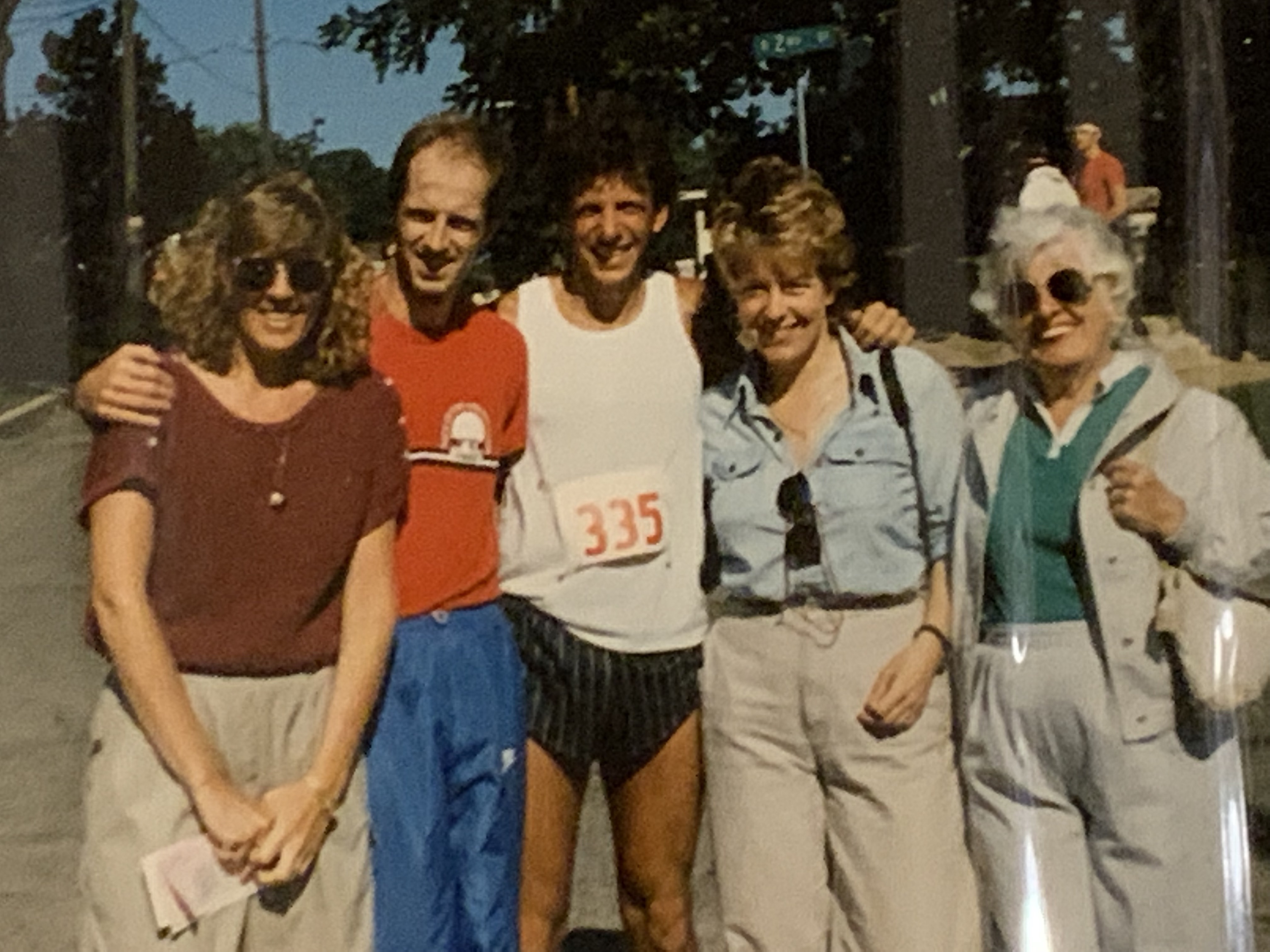
With my late wife Linda (left) best friends Greg and Francie, and my mother Emily following my win in the Geneva Community Classic 10K circa 1984
The long way around
During my late wife’s eight-year cancer survivorship, I sought counseling to help me manage caregiving for my late father as well. After a couple sessions, the therapist asked, “You seem good at forgiving others. How are you at forgiving yourself?”
That question answered numerous questions for me. It also allowed me to search past relationships and examine social (especially dating!) failures caused by that combination of early trauma, native anxiety and neurodivergent sensitivities. From then on, in my early fifties, I began building a different kind of self-confidence.
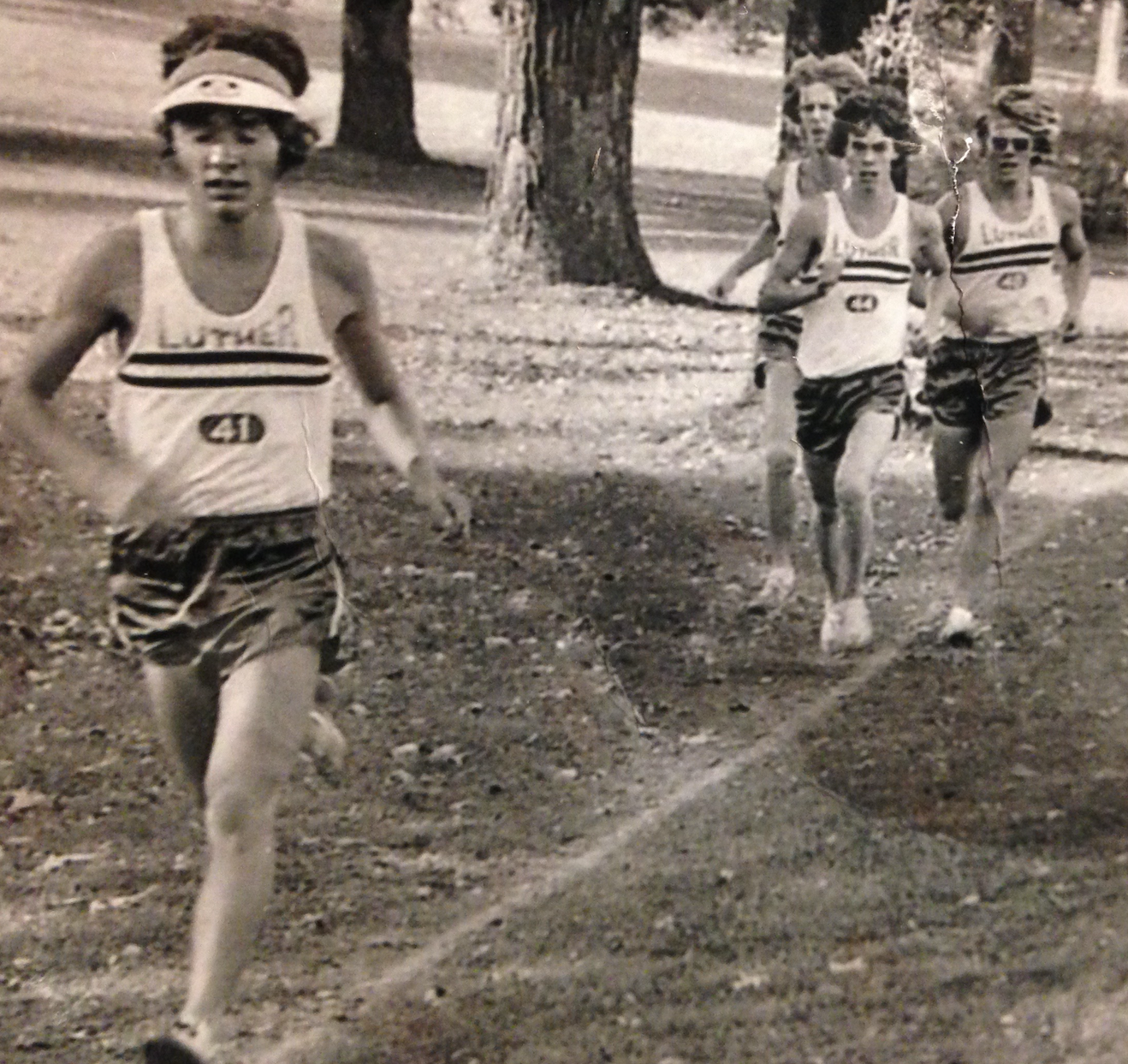
Racing in college cross country. Our team placed second in the nation.
Despite my lifelong struggles with a lack of self-respect and confidence, I achieved great things on many fronts. I led teams to national championships in running. I published art prints and won awards for design. I built a literacy project that grew to serve 375,000 families. And I’ve now published four books with several more on the way.
I also stood strong through ten-plus years of caregiving for my wife and father. Through that I learned patience which has an incredible effect, believe it or not, in building one’s self-confidence. I also grasped through experience that I have strong character under all sorts of duress. That strengthened my resolve and confidence in other ways. I walked out my father’s door one afternoon after my mother passed away in 2005 and realized, “This is all up to you, taking care of him now.” And I knew I could, and would, do my best at that.
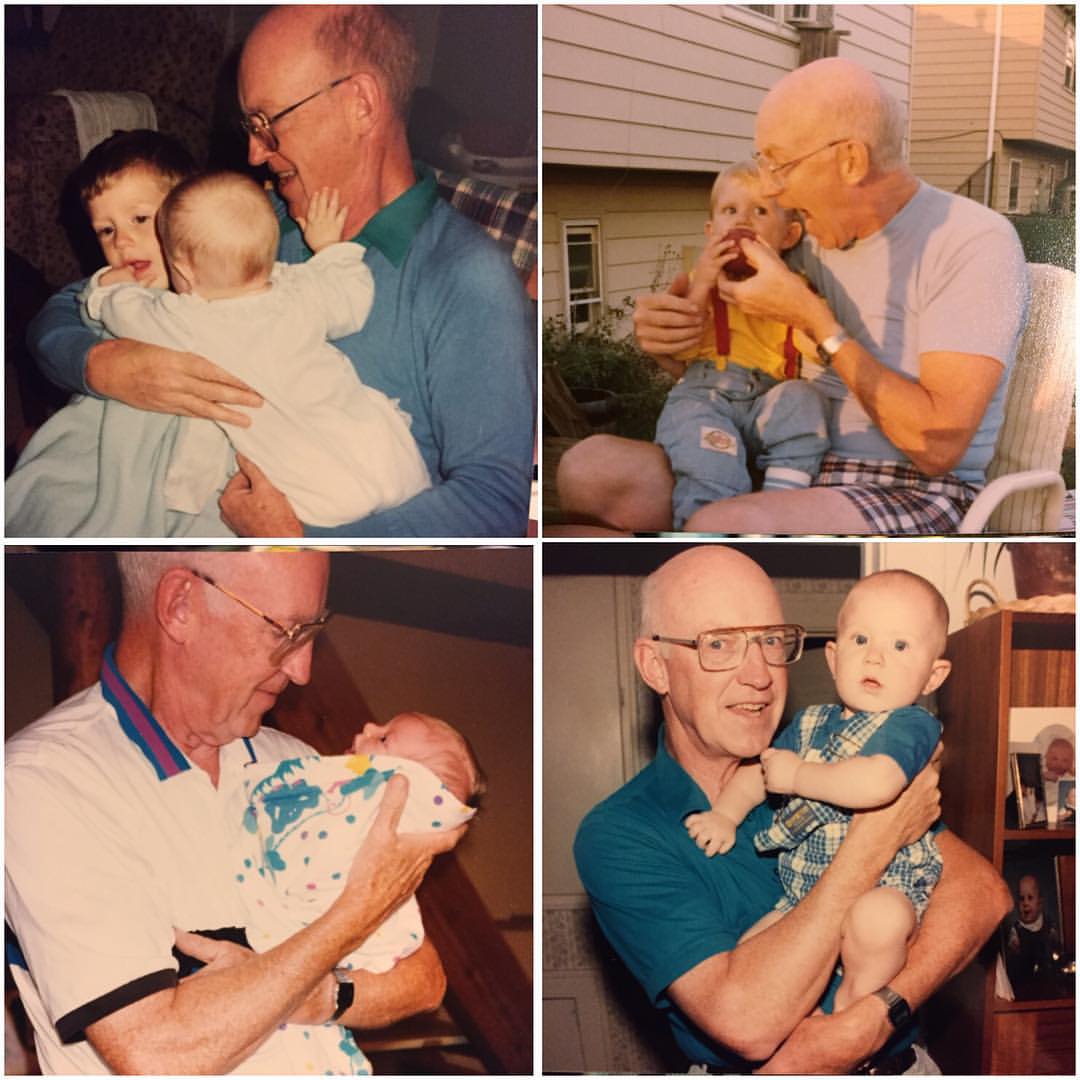
My father was in fact a loving man whose adoration for his grandkids proved it.
Which meant engaging with my father daily through all his medical and social needs. Over time, I came to realize that despite his fatherhood struggles raising four headstrong boys, he’d done much for me in support of my art and writing and sports. “Pay attention to your craft,” he once advised. That’s the best advice any father can give.
I believe I also helped my brothers dissolve some of their misgivings about our dad. Once the two eldest had trouble engaging with him, that ability improved in later years.
So, while the call of self-confidence waivers at times, and costs me opportunities due to fear, that’s my big “resolution” this year, to shove fear aside and continue on the paths I love. I hope you can too.
Are you overcoming fears this year? Share at cudworthfix@gmail.com
I’ve learned the value of humility the hard way, just like everyone else. As a proud young athlete growing up, my main concern was winning every contest I could find. My older brothers challenged me daily in sports ranging from table tennis to basketball and all points between.
Having older brothers toughens you up. I transferred that sibling rivalry to competing with friends and then participating in competitive sports. At the age of ten, I pitched our Local 285 baseball team to victory in the second game of the Lancaster, Pennsylvania city championship.
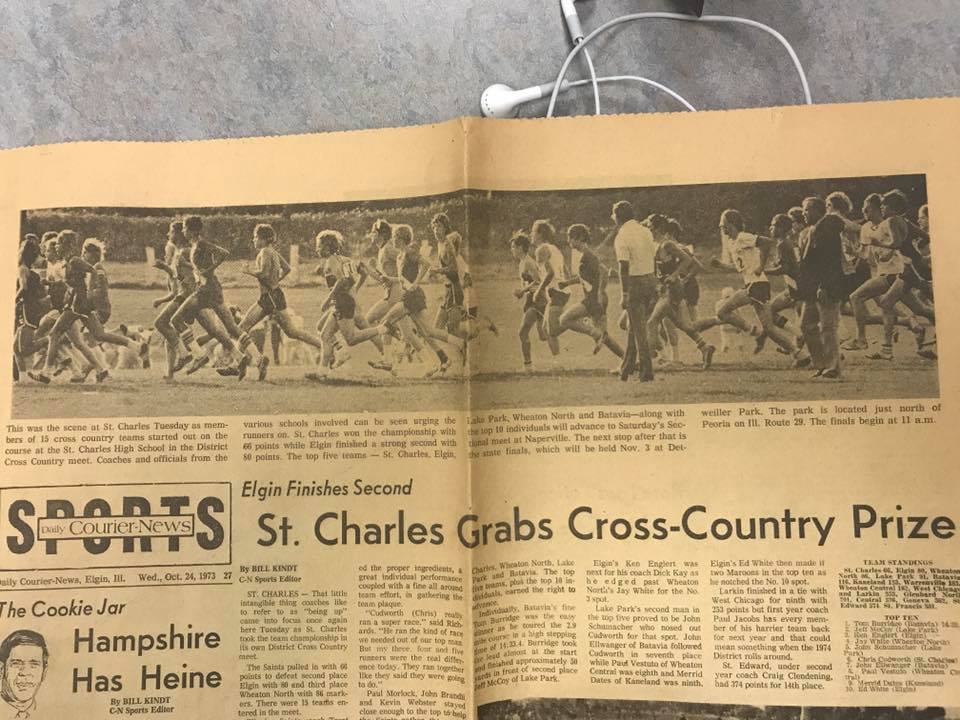
Throughout high school and college, I led the teams I played on, eventually turning to running full-time, where I ran as the first man on teams that won conference and district championships. In college, that success continued as I competed as a Varsity runner in a cross country program that won our conference all four years and as a senior captain ran in the Top Five all season, leading our team to 2nd in the NCAA Division III championship. In track I won conference three years and made Nationals three years in the steeplechase.
Even after college, I kept competing and set all-new personal records at distances from the mile (sub-4:20) 5K (14:45) 10K (31:10) 10-mile (53:30) and 25K (1:24:25). In my best year I raced 24 times and won 12 of those road and track races.
The reason I share this journey is to explain that all this training and perseverance was cited by my coach as having extreme value when my late wife was diagnosed with ovarian cancer in 2005. “Your whole life has been a preparation for this,” he told me.
But what I wasn’t prepared for was the degree of patience required to be a good caregiver. As a person with ADHD, I always struggled sitting still, waiting for things to happen, and not being able to “do anything” in the moment. Learning patience when you have to wait for hours to get results, sit in quiet (or noisy) hospital rooms at a bedside with your partner, and keeping track of important details day-to-day, these are all key requirements in a caregiver. I had to learn them. The hard way.
On top of my wife’s care I was caregiver to my father who suffered a stroke back in 2003. Through eight years of my late wife’s survivorship I tended to my father too. She lived through 2013. He lived through 2015.
I learned humility from all that caregiving. Never did I think that I was doing things perfectly. Mistakes are made no matter how hard you try. Sometimes, it’s emotional mistakes. Becoming impatient. Letting anger take over. Getting frustrated when the patient doesn’t seem to appreciate you. Feeling ‘put upon’ when relatives won’t or can’t step up to help.
And there’s money mistakes. Medical too. But you muddle through. But one thing that you learn from all that is practical humility. You don’t think of yourself as better than others. In fact, its possible to be too hard on yourself. One therapist called me on that one. “You seem to be good at forgiving others,” she reminded me. “How are you at forgiving yourself?”
Both of those traits require honesty. You have to “get real” in order to “truly feel” your purpose in the moment. Get to know where your weak points are, and understanding your strengths. Learning to lean on others when (and if) you can, and embrace vulnerability. It’s a superpower.
That brings us to the trouble with hubris. Once you’ve been a caregiver it’s easy to spot false pride in others. It’s painful sometimes to realize how insensitive and willfully ignorant people can be. In the United States, our healthcare system doesn’t favor the weak. It rewards the rich and employed and too often casually disregards those most in need. I read about how Black women can’t get a fair shake in medical offices because practitioner don’t take their word seriously. I’ve heard about other women than my wife feeling something’s wrong in their body and doctors just write off the bloating to water weight when in reality it’s tumors growing on their ovaries and spitting out fluids. By the time they’re discovered, cancer has advanced.
And when I see the callous way that certain political parties treat the healthcare system in America, it makes me angry. Now, I’ve been the beneficiary of non-profit forgiveness of medical debt, so I’m not personally complaining. One time AT&T even wrote off a $500 cellphone bill during one of my wife’s most tenuous cancer recurrences.
But the idea that rich people are now running around passing judgment on programs like Medicare without considering the life stories of those insured through it, or maligning folks counting on Social Security they’ve saved for decades to support them in elder years, it makes no sense why people vote for the hubris of these greedy freaks whose money obsession says more about their own fears in life than it does about their supposed success
Hubris is the opposite of humility, the quality that makes us all better people whether we’re caregivers or not. When you look to leaders, take stock of where their humility meter reads. If they’re arrogant and dishonest, don’t throw your trust their way. They’ll only use you and discard you as fodder for their selfish ways.
My late wife Linda during the first year we’d met in the early 1980s
Tomorrow, March 26 of 2024 will mark eleven years since my late wife Linda Cudworth passed away. She survived through eight years of ovarian cancer, a Stage IIc diagnosis that proved persistent and aggressive through multiple surgeries, chemotherapy treatments (literally dozens in cycles of 5-8 at a time) and the pursuant side effects ranging from destroyed taste buds to feet and hands numbed by neuropathy so bad she could hardly manage to do the thing she loved most, which was gardening.
Yet persist she did. Long enough to see her son Evan graduate from college and begin work. And nearly long enough to see her daughter Emily graduate as well. It wasn’t an easy period for either of them, working in New York as Evan did at the time, and Emily looking to finish up college at Augustana while her mother’s health declined. Those events and the aftermath affect us all to this day.
Corporate wealth versus public health
But I also want to talk about something I’ve never fully addressed. That is, how the world and its work and healthcare systems treated us from the minute we received that initial diagnosis back in 2005.
At the time, my mother was also already fighting lymphoma with oral chemotherapy because she wanted to stay healthy enough to care for my father Stewart, who had a stroke in 2003 and never really recovered. His apraxia and aphasia stole his speech, and paralysis on his right side took away many of his other activities.
That made me the primary caregiver for both of my parents. So when the cancer diagnosis came along for my wife we were already dealing with considerable issues related to insurance and caregiving. That November, my mother was additionally diagnosed with pancreatic cancer. She died after one chemo treatment that produced in her a life-ending stroke.
At the time, our family healthcare plan was administered through my employer the Daily Herald, a newspaper media company. We chose an HMO to save costs, but what that really meant was that our doctor options were limited by our plan. We were balancing our healthcare needs against all the other expenses we faced in life at the time with kids in high school and college.
We were just trying to get along. In the early 2000s we lived on my salary of $75,000-$80,000 a year. I also made an additional $15-20K per year freelancing, often working early mornings and late evenings as a remote freelance creative director and copywriter for an agency I’d later join as an employee. We used my wife’s preschool teaching income of $18K to save up and pay for my son’s college costs at the University of Chicago because our FAFSA was about $16K per year.
The Gold Standard
Linda had surgery in 2005 to remove the remainder of the ovarian tumor that the naive gynecologist had broken during exploratory surgery to check the cyst. That accident revealed the cancer, and it also unleashed millions of cancer cells throughout her abdomen. These implanted on the abdominal wall. We were grateful to find in our HMO a premiere gynecological oncologist named Dr. James Dolan who did investigative surgery to remove cancer. In a post-surgery meeting with me in a closed room, he quietly told me that her abdominal wall “felt like sandpaper” thanks to the cancer cells growing there. “I extracted as much as I could,” he told me.
After that, we proceeded with intravenous chemotherapy to kill as much cancer as we could without killing Linda. Then they recommended a “Gold Standard” tactic of dumping chemo directly into her abdominal cavity through a port in her belly. The nurses actually nudged the port loose with one treatment and the chemo spilled out making a white stain on her skin.
We probably could have sued over that, but our biggest concern was getting through the chemo so that she could return to something resembling a normal life after months and months of her being sick and tired and fed up with the entire debacle.
HMO ills
Our annual family vacations to Seven Mile Lake in Wisconsin were a tradition
All the while we wrestled with HMO bills and tried to keep up with our payments. Upon signing up for the HMO, we had to switch family doctors, leaving behind the physician that Linda trusted most. That practice, one that I’d been attending since I was twelve years old, no longer accepted the Blue Cross HMO we’d chosen. It’s a tragic thing when an insurance system takes medical decisions out of people’s hands.
To make matters weirder for me, during same time period my boss at the newspaper decided to conduct a 360-degree review on my performance at the company. Needless to say, I was a bit distracted that year. Thus the review held plenty of criticism. I’d been Administrative Associate of the Year in 2003, so I wasn’t a slouch of any kind. But thanks to the burdens of caregiving for my wife and parents, juggling bills and kids in college, and commuting all over five Chicago suburban counties to run the marketing efforts of six bureau offices, the year 2005 was not easy for me under the circumstances.
Yet despite these pressures, I still managed to grow a literacy project that represented $27M in market value to 375,000 families. My role also involved conducting 200 annual events as well as several dozen awards banquets, symposiums and sales programs for a newspaper with a circulation of 140,000 or so. Amid this flurry of activities, I had some problems, yes. But it also would have helped not to have been put under a 360 degree microscope while dealing with everything going on at the time.
Bigger money
I ultimately left the company in 2007, joining the agency where I’d been freelancing. Linda’s health was by then stabilizing. We felt like it was a good time to make the change given the failing nature of the newspaper industry. The Internet was stealing revenue and kicking the ass of nearly every newspaper in the country. Dozens were going out of business. I’d just won a $1M account for the agency by leading a pitch to a giant men’s clothier chain based out in Richmond, Virginia. My new salary would be $110,000 a year, almost $30,000 more than I’d been making at the newspaper.
But then tragedy struck again. Within a month of starting that new job in the summer of 2007, Linda’s CA-125 numbers began rising. The surgery and chemos she’d endured the previous years were not keeping the cancer at bay. It came back hard and fast that summer. The disappointment of having done the “Gold Standard” and having the cancer come back so fast was too much for Linda. She had a complete emotional breakdown, screaming in anger when we got the call that cancer was back. Her personal affect collapsed. Her parents spent time at our home during the day yet I spent every other hour at work checking on her as needed. My own performance suffered, and before long, the agency elected to fire me.
I get it. Company leadership wants positive, high-performing employees. The boss of that firm once looked at me and complained, “I like you better when you’re smiling.” I was just trying to survive at the time. I’d spent so much time on the phone during those months that I received a $500 cellular phone bill from our cellular provider. I took the bill to a local store and explained our situation. They told me that they’d credit back the entire bill. No charge. Obviously I thanked them profusely.
Back on the job hunt
My photo of a juvenile bald eagle.
But I was still out of work. At that point, cancer families have a choice to make, and it’s not pretty. Within a month or so, payments must be made to continue COBRA insurance coverage. That means the patient assumes the total costs of insurance. In our case those costs totaled $2000 a month. That’s a ton of money to pay before even considering monthly bills. So there I was, out of work with just a nest egg of cash available, suddenly thrown to the insurance wolves.
It took months for Linda to emerge from the depressive episode brought on by the emotional collapse. She could only bear to leave the house for short periods, usually with me, or sometimes, with her parents. Even that was tough. Meanwhile, she’d developed a condition called ascites, a swelling of the abdomen due to fluids caused by cancer. One night I walked in to find her lying on her side with the light in her eyes flat and nearly lifeless. I helped her into the car and we rushed to the hospital. The medical techs proceeded to drain several liters of fluid out of her gut. That can only be done a few times as the procedure has risks of causing infection and other problems. We needed to get her back into chemo to kill off the cancer that returned. The rest of 2007 was spent getting those treatments as occasionally her most trusted friends sat with her at the cancer treatment center if I had job interviews or freelance gigs to handle.
Making do
I got to work again by 2008, accepting a lower-paying job nearer to home at an audio-visual company. The salary was just $60,000, about half of what I’d been making at the agency. I took the position because there were some energetic young associates that just started at the company, which planned to launch a student response system for the education market. There was growth potential if that succeeded. Mostly I took the job so that I could be near enough to home to take care of Linda. She was going better again, having survived even more chemo and another surgery, but this time her hair fell out even faster and her hands went numb. She bought wigs and wore gloves to do her gardening.
The bills continued to escalate during that period. The costs of chemo and surgery shot up so high that we could not afford to pay for it all, a total of nearly $100,000 built up. I learned that the hospital where we having treatments done was a non-profit offering financial assistance. To my amazement, they reviewed our financial situation and agreed to pay 90% of all our bills. I sat at home that night crying in thanks. On that subject, I greatly admire wealthy people moved to support healthcare and hospitals. They rightly deserve to have their names on the facilities. Thank you. That’s indeed a beautiful thing that wealthy people do.
Ugly questions and healthcare roulette
That still leaves some ugly questions. Why does our insurance system work like this? It’s clear that no one really knows what’s going on with actual patients and their medical bills. I’ve long been a proponent of a national healthcare system for these reasons. The US should be like so many other countries around the world, investing in the health of its people rather than forcing them to play healthcare roulette.
In this country, real, everyday people feel the ugly brunt and abuses of the for-profit healthcare It’s an ugly process in which insurance companies, healthcare providers, the government, and employers small and large all battle over who should pay for what. All we know is that the costs of health insurance rises year after year. During the eight year reign of President Bush, the costs of health insurance rose by *96% and millions of people remained uninsured.
*Source: Crain’s Chicago Business
Money drains
That leaves people heading for the emergency room if they’re uninsured, driving costs higher and reducing effectiveness of care for everyone. It’s unexcusable that a developed nation such as the United States of America carries on like it does claiming that it offers the ‘best healthcare system in the world.’ Yes, we have many advanced and amazing healthcare opportunities in this country. But what does it mean that our doctors hate it because they’re in debt up to their ears from paying for their medical education, and the cost of insurance for their practices is skyrocketing too. Meanwhile, nurses suffer long hours and hospital systems try to nick every dime out of patients just to stay afloat. Money consistently drains down the sinkhole of the American healthcare system. It’s a national debacle. A shitshow.
To make it all worse, many companies fear having their insurance rates go up every year. This is true for companies small and large. Once the recession hit in 2008, there were many small companies struggling to survive month-to-month while banks refused to offer loans to cover payrolls or operating expenses, much less insurance costs.
By 2010 my job at that little audio-visual company came to an end when the rescue dollars offered by the Obama administration to fund educational technology ran out. “Sorry,” I was told. “We don’t see the same business coming through this year. We have to let you go.”
Well, that was also a lie. I’d researched and landed a former business line with a huge educational supplies company eager to sell our firm’s AV equipment through their national channels. But because that firm competed with the localized dealer network and the Good Old Boy system it relied upon, the company’s President and top salesperson fought the supposed incursion upon their territories.
I’d studied the previous sales reports showing that the education company had once done $600K in business with our firm. With another salesperson I visited the education company, re-opened those sales channels, helped train their people and provide them with marketing materials, and brought in a quick $1M in restored business that year for a firm doing $20M annually.
But our internal audience was not in favor of the change. “Our dealers don’t like their salespeople calling on their schools!” they protested.
“When was the last time any of those dealers actually called on those schools?” we responded.
“Well, they plan to…” was the weak response. We’d learned that the new sales channels threatened their anachronistic methods of doing business.
We might say the same thing about our healthcare insurance industry and its anachronistic corporatized structure. The “old ways” of doing business are clearly not efficient or effective for anyone. The possibility of competition from a national healthcare system to regulate and negotiate prices is too much of a threat to Big Pharma and the likes of United Healthcare and other monopolistic healthcare insurances hogs feeding at the trough of unrestricted data, access and profits from the American population.
No agency at another agency
I searched far and wide for a new job and got a position at an agency forty miles away. During the onboarding process, which was conducted by the wife of the company’s owner, I hesitated filling out the information on the health insurance forms because it would mean revealing my wife’s cancer. I considered not telling the truth, but reasoned that could lead to a lawsuit. So I filled out the paperwork honestly and turned it in, knowing that it might raise red flags in the minds of the couple running the company. From the get-go, I worried about that.
Sure enough, after month I was suddenly shifted to an inane sales position requiring me to drive all over the Chicago area handing out bottles of promotional pepper sauce as a device to land marketing work for the agency. It never worked, and of course, I didn’t land much business. I quietly asked, “Shouldn’t we be using the marketing techniques we teach our clients to market our own firm?” For some reason, that was ignored. Ultimately, they pulled me into a meeting one day and said, “You’re just not cutting it. We have to let you go.”
I resisted and specifically pointed to the fact that I was shifted away from the original responsibilities to engage in a crazy proposition that no one could fulfill. Later that day, I wrote them via email because I’d done my research before leaving and talked to the broker that sold them healthcare. “I can stay on their plan, right?” I asked. He assured me that the law required that I be offered that opportunity. But the company tried offering me a $1500 stipend toward whatever insurance I could find. At that point, I contacted a lawyer friend. I accepted their $1500 offer and also stayed on their insurance until I found a new job.
Bad scaffolding
As I understand it, the entire American healthcare system is built on a scaffolding of bad policy originally constructed as a sort of “incentive” or “benefit” to attract employees. The healthcare system we developed relies on this quasi-capitalistic notion that we should all get health insurance through our employers.
But if supporting and defending capitalism were truly the mission of the American healthcare system, businesses would have nothing to do with health insurance at all. That would eliminate the massive costs and time spent by HR resources negotiating and managing company-sponsored healthcare plans. Our corporately sponsored healthcare system is a fraud. To make matters worse, the politicians responsible for legislating healthcare are in many cases funded by the profit-based companies benefitting from the waste and corruption integral to our system.
The laws governing small companies are vague and frankly, rife with loose language and utter bullshit about what they can and cannot do to hire and fire employees, much less provide access to healthcare insurance. If a company has less than twenty employees, they get a ton of leeway in how they can screw people over. I know that it’s hard to run a company of any size. I’ve seen it firsthand. But I also know that there’s a right way and a wrong way to treat people. I’ve seen that firsthand too.
After I left, one of the employees at the first who knew my situation called to offer condolences. She told me, “Don’t fuck around with these small companies,” she warned. “You need to get a job with a big firm with good insurance.”
A CMO still hiding the Big C
I tried to abide that advice, but the job market was still tough in 2011. I applied and was hired for a position as Chief Marketing Officer at a PR firm. Things went well for a year. I earned a number of national public relations awards for clients large and small, even bringing 2000 people the grand opening of a ReStore.
The company’s owner knew and liked me, yet in the back of my mind I remained cautious because during the interview process she’d openly stated, “The only reason we can offer insurance here is because no one’s had cancer.”
I have a labor law attorney friend whose firm once faced rising insurance costs. His partners were angered by the fact that his wife had a couple surgeries to fix scar tissue related to horseriding injuries. “Your wife is driving up our insurance costs,” they complained. But when the broker from whom they purchased their insurance explained the rising costs, he told them. “It’s not her surgeries making the costs go up. Both of your wive’s are in their child-bearing years. That costs more money to insure.”
The fact of the matter is that virtually no one understands our insurance system in America.
Fortunately, in the case of that little PR agency, I was able to fill out and submit our health insurance forms without sharing them with the office manager or anyone else at the firm. I mailed them directly to the insurance provider. I believe that’s how it’s supposed to work. And don’t HIPPA laws require it in some fashion? Yet many small firms ignore such requirements.
Even with that precaution, I’d soon run afoul of that firm’s insurance fears and other policies related to employment.
A grudge and payback
After traveling to Colorado Springs on a client recruitment trip at an event where large firms met with PR firms like ours, I was accosted by a fellow employee who was angry that the owner had spent $35K to attend. “We won’t get a bonus this year, I bet,” he complained. In turn, I explained that we were trying to up our game and bring in new and larger clients so that we’d all make more money. Instead, he bitterly blamed me for supporting her venture. In fact, he made a practice of complaining about her every time we went to lunch. I didn’t know that his disenchantment would soon cost me directly.
In the spring of 2012, Linda’s cancer came back. This time it would require yet another surgery involving a complicated extraction of cancer from her liver and colon, where it had spread. With the surgery approaching and the need for some time off possible, I considered telling the company about her condition. Yet I feared getting fired if they found out my wife had cancer. I’d been enough nuttiness to know that anything could happen.
As an insurance against my own risks, I worked hard the last two weeks before the scheduled surgery trying to land a big client. I figured that might stand up against any potential costs we might incur if our company’s insurance coverage shot up.
On a Sunday night, a bit anxious to make something happen I’ll admit, I opened up my personal website and posted one of the successful creative campaigns I’d just produced with an in-house designer. I was trying to reach a network of people through my own website that might be able to provide a referral for new clients.
The pressures were getting to me, so I decided that Monday morning to tell the owner and the HR director about my wife’s condition. They expressed complete support for our family. After all, I’d attended every company event and brought some recognition to the firm, including a complete re-write and design of the company’s website. I thought I’d built some loyalty and value. They assured me that I had.
But that afternoon the post of content to my website generated a Google Alert about the client’s name. At that point the disenfranchised employee came to my office with a stern look on his face and said, “You need to take that down right away.” So I did. It had stayed on my website no longer than ten hours. It was highly unlikely anyone even saw that post. But the copy mentioned the client’s name. Technically, I’d committed an error in judgment.
Getting fired is no fun
I walked into work the next morning to be greeted by the owner, whose stern look told me something bad was happening. The entire office was silent as they led me to the company conference room and informed me that I was being fired for breaching the company’s policies on client confidentiality. “That’s weird,” I responded. “They’ve already published that work in a magazine.” They didn’t care, they told me. I’d put the company at risk.
The lawyer they hired sat in the room and read me some legalese. Then I was told to gather my personal effects and leave. If you’ve never been fired from a job, it really is no fun.
That afternoon I contacted my best friend who is a labor law attorney. He gave me some advice to follow for an upcoming hearing on unemployment insurance but he was busy with his full-time job the day I was to have the hearing. It was conducted by a Chicago employment judge. In advance, we were told to exchange relevant materials so I submitted proof that my post had done neither the company or the client any harm. However, I never received the information they were supposed to provide me.
Upon mentioning that to the judge at the start of the hearing, he told me not to speak until spoken to. From there the case was railroaded and I was also blocked from collecting unemployment insurance. In sum, that disgruntled employee had fucked me over in spiteful revenge over my support for the boss’s investment in client recruitment.
Lessons learned
I’ll end this story there, because not long after that debacle my wife’s condition got worse. Her own father died of heart complications in late 2012. Then on December 26 of that year we learned that her cancer had migrated to the brain.
The doctors told us, “That’s not supposed to happen.” But it did. We engaged in brain surgery using radiation. Then they put her on steroids for the swelling. That made her kind of energetically crazy in early 2013. We even had to counsel her to stop teaching preschoolers because her judgment just wasn’t right. That broke her heart. And mine.
When the steroid treatments ended her body mercifully gave out but her mind never did. We’d done our praying and told each other of our mutual love. She died peacefully the evening of March 26 after the hospice team visited her that afternoon.
I’ll admit I was grateful and relieved that she was freed from the misery of the cancer that caused her distress all those eight years. Despite it all she lived as fully as anyone could, planting amazing gardens, raising monarch butterflies from eggs on milkweed leaves, and loving her own children and those she taught with all her heart. She was 55 years old.
But my point in this essay is that I still cannot believe this is the way that human enterprise is supposed to treat those facing illnesses such as cancer. In its broadest sense, society is still primitive, tribal and brutal in its methods of care as far as I can see. Corporations can toss people around at will, it seems. Our healthcare system favors the rich and spits on minorities, women and anyone that fails to fall under “covered categories.” Is there any more inhumane system on earth? Probably so, but we’re supposed to be better than that. Instead, we’ve got greedy fake Christians and their hypocritical political partners claiming to be Pro-Life while constructing death panels based on who can afford to pay for insurance, and who cannot.
Fortunately, there are still many kind and wonderful people who break through the ugly facade of America’s healthcare system to offer great care and financial support. But they fight against a system more concerned with corporate wealth than public health. And that’s the real cancer in America.
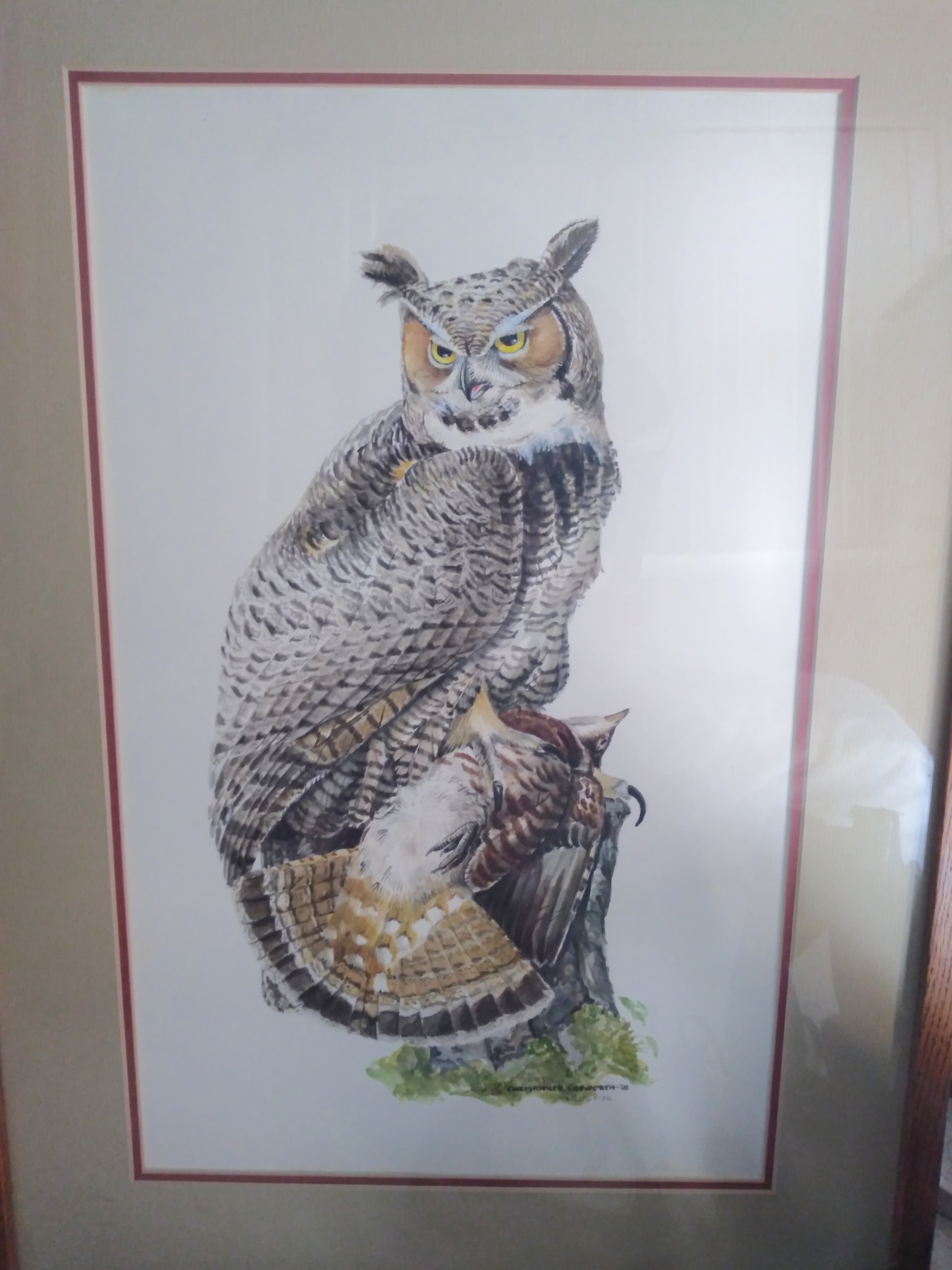
Last Friday night I sat down to check email one more time before relaxing for the evening. There was a message from a website called FineArtAmerica. A woman named Delinda was writing to inquire about a painting that she owns. This is what she wrote:
Good day, I am inquiring about this magnificent print of yours, titled on back in handwritten notecard, reads: Great Horned Own with Red Phase Ruffed Grouse. 3/5 life size. Curious, it says ’78 perhaps as a date? I can send pics if you need to see it, hoping to get more info about who it may have been commissioned for, or if its just a random print? I love it so much, its so lifelike it scares my cat lol. Thanks in advance, Delinda
This is a watercolor painting of mine from 1978. I produced it and sold it during a show in the Preus Library at Luther College just before Christmas.
The painting was a labor of love a long time ago. It bears similarities to a watercolor by an artist that I admired and emulated. His name was Louis Agassiz Fuertes, one of the greatest bird artists that ever lived. I’d gone to Cornell University Laboratory of Ornithology to study the work of Fuertes and other great bird artists. I did my best to absorb what I could from studying their work close up.
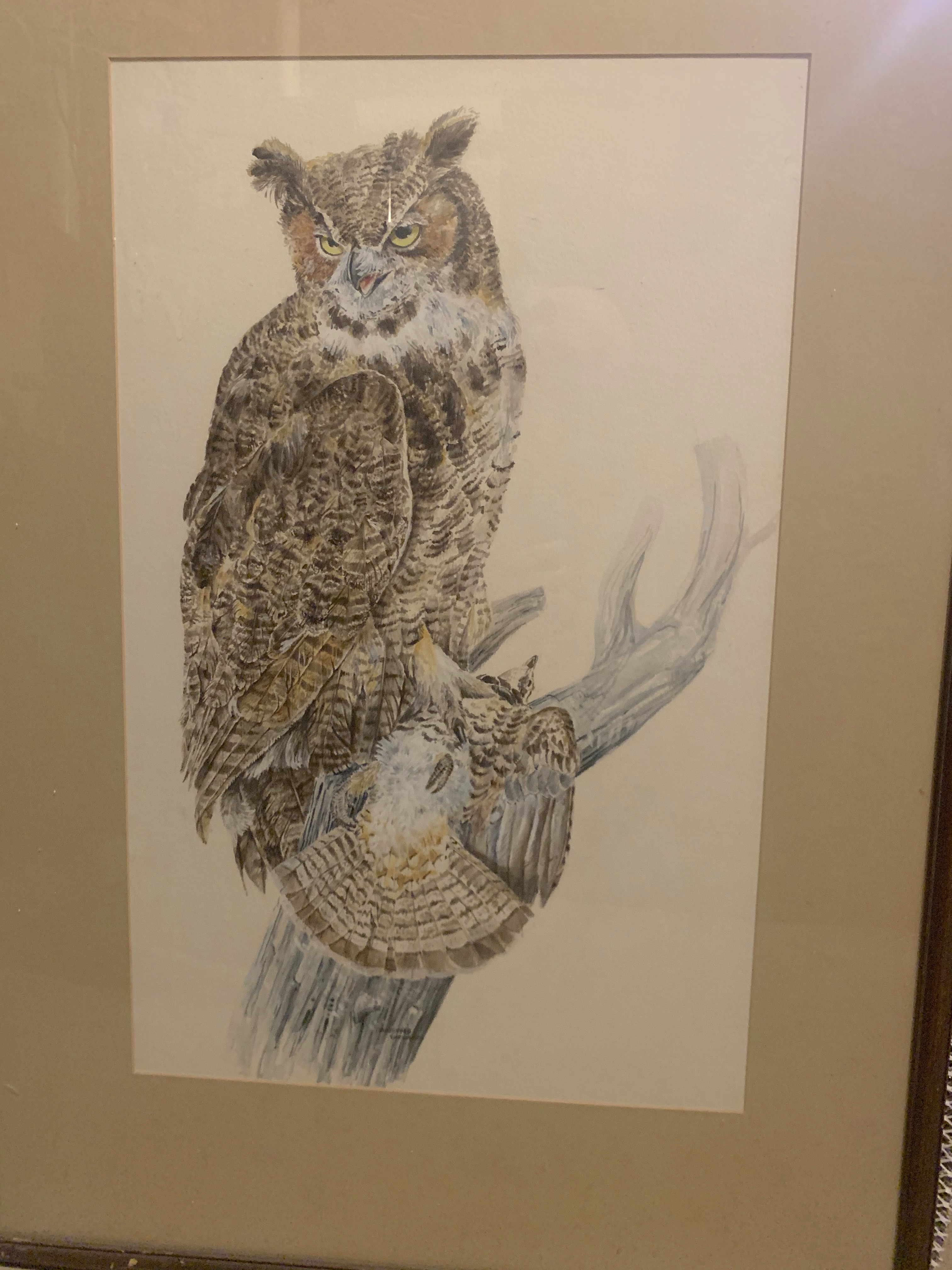
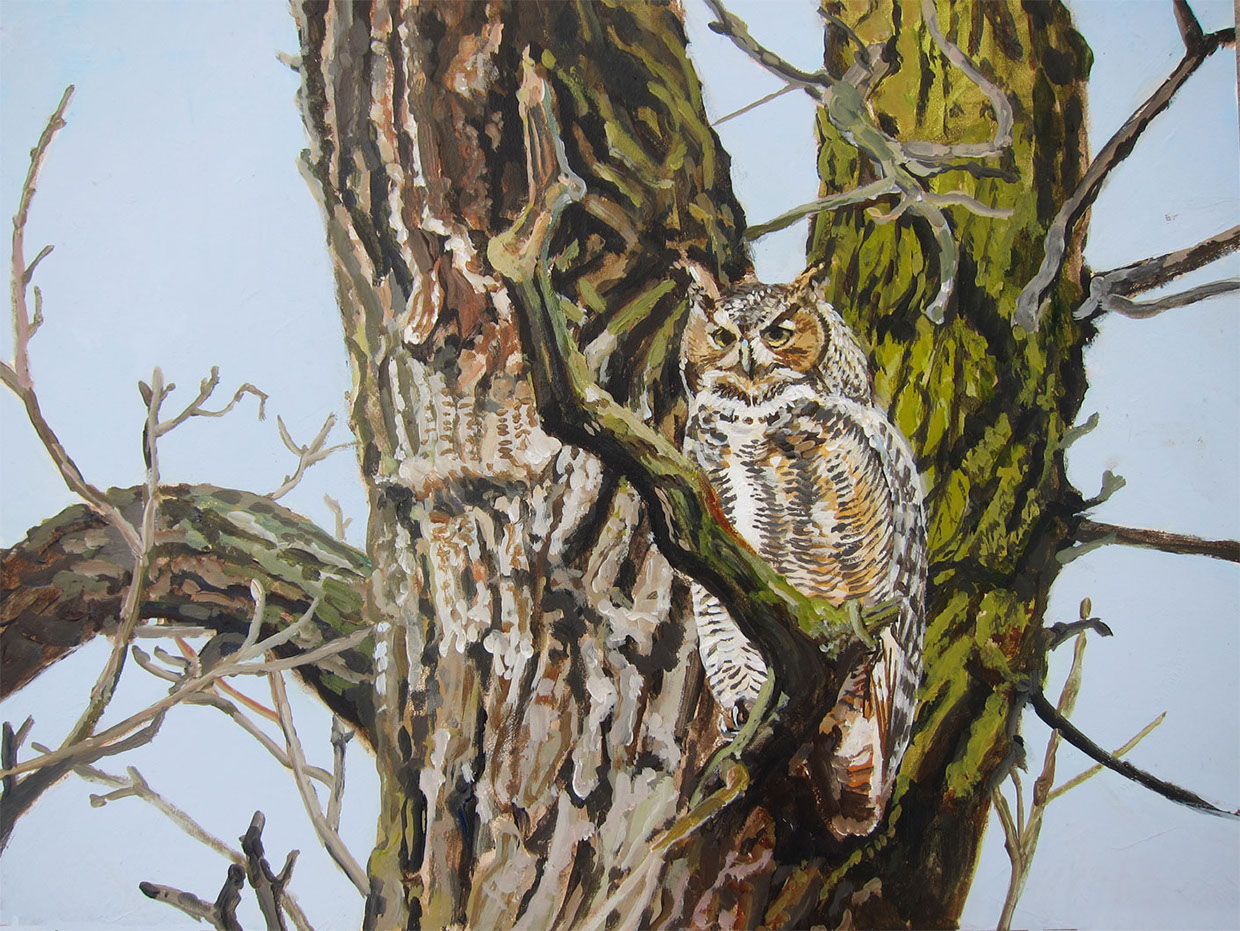
My aspirations were to become as great a bird artist as I could. This particular portrait was a refinement of an earlier study I had done. I also executed an ink drawing of the same pose. But the pose originated from a painting I produced as a freshman in college from a stuffed great horned owl borrowed from the biology lab. That painting copied the mussed up feathers verbatim, a condition that a live owl would never likely allow to happen.
The great horned owl painting produced in 1975 from a stuffed specimen.
When I showed the 1975 painting to Dr. Lancaster, the Director of Laboratory of Ornithology, he blurted, “That’s some of the finest featherwork I’ve seen.” I took that as a kind compliment. Clearly he saw my potential, but also noted that much further study of birds was in order to become a fully accomplished bird painter.
That I continued to do. But the challenge was finding suitable resources. I’d learned taxidermy in college, but it was illegal to collect and own dead birds of any kind. Still, I collected specimens and kept them in our second freezer for reference. I owned a camera with a 300mm lens but never seemed to get good quality photos to copy. Plus it takes years or genius to absorb and render the “true” lines and forms of birds in the wild.
The years passed and I produced hundreds of paintings of varying quality for patrons public and private. Almost all of those are in the possession of people whose whereabouts I do not know. Occasionally I’ll be contacted by someone who wants to know if I’m still painting. We have a good chat and they send me a picture of the painting they own. That makes me feel good. Someone prizes a bit of my work.
I’ve even gotten calls from strangers who came into possession of one of my paintings. One of them started our phone conversation with a question, “Are you famous?” They’d picked up one of my watercolors at a garage sale of a couple getting a divorce (I remember the couple) and wanted to know if the painting they’d purchased for $25 was worth a bunch of money. “I hate to disappoint you,” I related. “But I’m not famous.”
Last year a friend found one of my paintings at an antique shop in Michigan. They were browsing the store and saw a painting of an eagle that I’d painted long ago. I’d done the work on commission for Robert Van Kampen, a patron who went on to sell his investment company to Xerox for $400 million. He hired me to do a series of hawk paintings when I was 18 years old. Somehow it escaped his estate and has been kicking around antique shops the last forty years.
Last Friday night, I wrote back to my new friend Delinda thanking her for getting in touch with me about the owl painting from ’78. She explained how she came to own it.
“So happy to hear from you! I live in San Diego, ocean beach, and people leave things in alleys all the time. The owl I’m guessing was from someone older who may have passed away. I’ve had it for about 5 years now. It was in an alley for about ten seconds before I grabbed it, others really wanted it too but I won lol. I knew it was special, and would be happy to return to you if you’d like it, or donate to the school or elsewhere that might appreciate it. Otherwise, I will cherish it forever, as I love owls and birds! XO”
I told her that I wanted her to keep it for as long as she wanted it. We agreed that if I get out to visit my son in Venice, California, we’d get together as friends and share a drink by the ocean.
That’s the most an artist can hope for in some ways. That the work builds connections. I’ll not pretend that I became one of the world’s greatest bird artists as I once believed was possible. But I also haven’t quit. These days, with the camera and lens I now own, and ability to collect good reference material, my work has improved and continues to do so.
I may never be a Louis Agassiz Fuertes. No one ever will. But I can be the best Christopher Cudworth that I can be. That’s the art of not being famous. And that’s the right kind of pride.
Painted in 2015 from a photo of a great horned own at a local forest preserve. The composition is fuller. The rhythms of the bark and the markings on the owl match.
I recently completed work on a book titled Rescuing Christianity from the Grip of Tradition. In recognition of Earth Day 2020, here is a short excerpt from a chapter titled Cause and Effect, which addresses human influence on the environment, and how people claiming dominion over the earth have gone so far it now presents an insult to God.
Cause and Effect
To answer the question of whether God is angry with one nation or the other, we need first to consider how we view natural disasters. Earth history has always been driven by events such as volcanic eruptions, floods, tornadoes, hurricanes, and earthquakes. These natural cataclysms have shaped the world. Some of these events we call an “Act of God” because their scale and impact is so sudden or massive that we feel moved to describe them in supernatural terms.
But the Dust Bowl was different. It was a prime example of an environmental impact caused by human influence. While natural droughts always occur on the plains, the Dust Bowl was a direct outcome of people plowing up the soil in regions that were ill-suited to their desired aims. Native plants on the Great Plains had evolved to survive in desert conditions and hold soil in place with root systems adapted to cope with a lack of precipitation. Cultivated crops offered none of those soil protections. Thus human beings were both the cause and effect of the worst problems associated with the Dust Bowl. That human impact upon the environment is now described as anthropogenic change.
Climate change
The world is witnessing even more natural disasters caused by human activities. The increased frequency and intensity of storms and droughts, floods and heatwaves, tornadoes, hurricanes, and sea levels on the rise were accurately predicted by scientists studying the possible impacts of climate change. Much like the case with the Dust Bowl, the Earth’s overall capacity to repair and replenish itself in the face of human onslaught is being exhausted.
Given the wide range of deleterious effects caused by human activity, one can logically argue that the human race constitutes a plague of its own. The world’s human population currently stands at 7 billion people. The United Nations projects that the human population will reach 9.8 billion people by the year 2050 and 11.2 billion by 2100. At what point does the human toll on the planet reach a tipping point?
The Earth groans
The Earth’s capacity to sustain life and replenish itself is being sorely tested. Fish stocks around the world are suffering steady depletion. Coral reefs that act as fish breeding grounds are dying due to ocean warming. Plastic waste pollutes the ocean, killing fish and cetaceans that ingest it. Nuclear radiation from Japan’s damaged Fukushima power plant spreads across the Pacific. Drought-driven fires in Australia burned millions of acres. Fires set in Brazil’s Amazon jungles to clear rainforest for agriculture rob the world of oxygen-producing trees and plants. The planet is groaning under the burden of sustaining human consumption and greed.
These are all the outcomes of human influence over the environment. In combination, they threaten the existence of life itself. That is an insult to God’s creation.
Christopher Cudworth is author of the book The Right Kind of Pride: Character, Caregiving and Community available on Amazon.com.
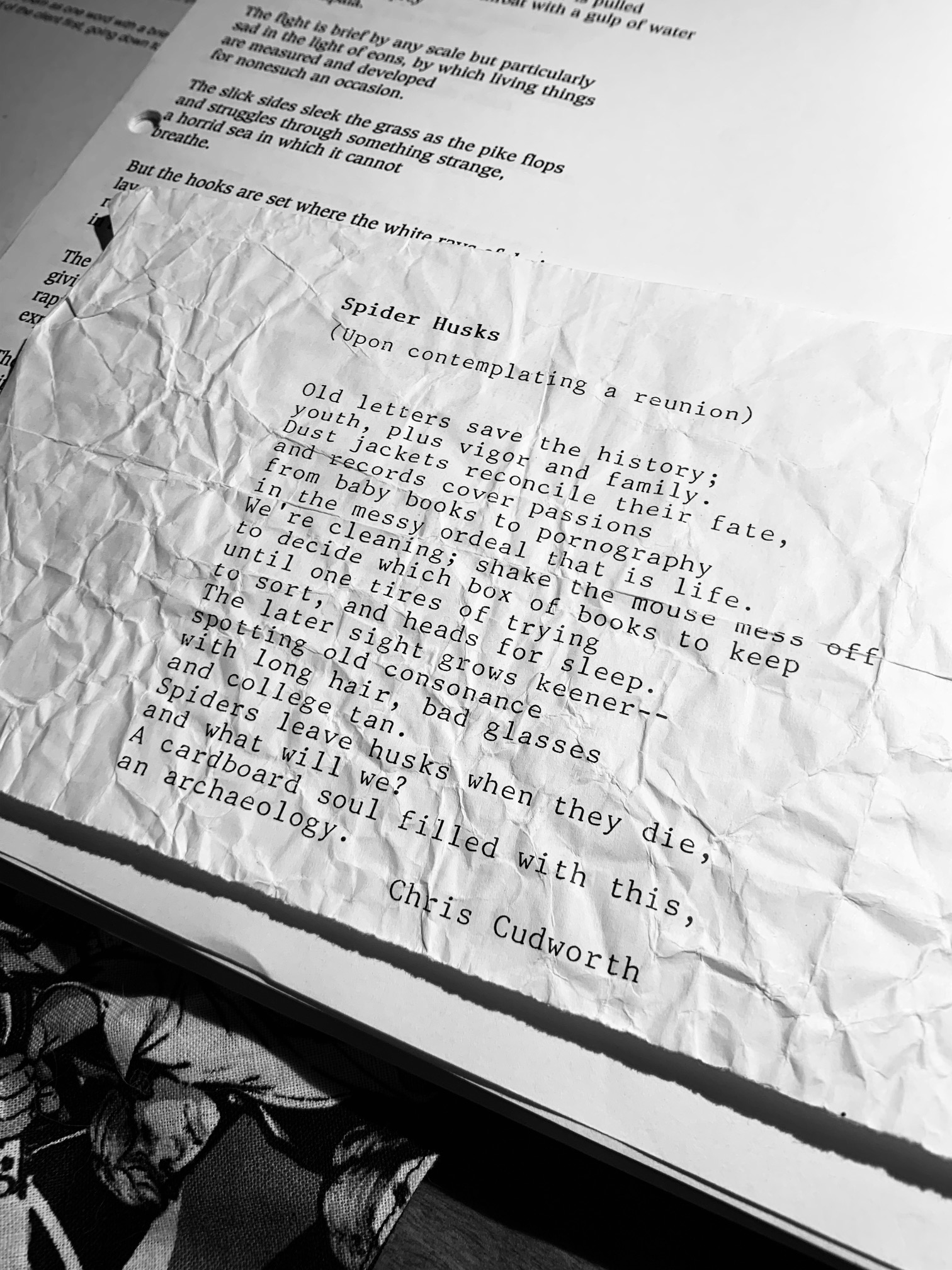
Over the years I’ve written dozens of poems along with acres of prose. Some of them have been published officially. But many reside in digital files or yellowed folders where they do not see the light of day.
I’m now finishing work on a new book titled Rescuing Christianity from the Grip of Tradition. It is a followup to the original book on theology that I published in 2007, titled The Genesis Fix: A Repair Manual for Faith in the Modern Age. I’ve assembled that self-published book to print it again through Amazon.com, since the first 250 I produced are largely sold out. It is a treatise and a warning about the effects of biblical literalism on politics, culture and the environment. 100% of it has come true in the last four years.
When those projects are done, and I have another couple books in the works, I think I will publish the poetry and the title of the book will be Spider Husks, named after this poem I wrote before a ten-year college reunion. In the face of all this madness in the world, it somehow seems poems are the best response.
I just finished reading the book Wild by Cheryl Strayed. Many times I’ve watched the ending of the movie made from the book. I liked Reese Witherspoon’s portrayal of the author. The thrills and the sex and drugs. The pain at losing her mother, portrayed by Laura Dern. The lost feeling that followed. Her divorce that was more like two boats drifting apart.
And then the hike up the trail from California to Oregon. Recovering, what? She did not know going in how difficult it would be. The pain of hiking. The busted up feet. The callouses on her lower back that felt like leather.
I’ve read other “journey” books and really liked them. A Walk in the Woods by Bill Bryson chronicled his hike up the Appalachian Trail. His journey was more about the doing than the catharsis. But it wound up being a catharsis just the same.
In every journey book there is a similar dynamic. Isolated from everyday life, the lead characters wonder, sometimes with guilt, sometimes not, what might be going on back where life is normal.
For Cheryl Strayed, it was getting away that mattered. It was everyday life that had trapped her with its sorrow and its temptations. She’d done heroin and slept with a bunch of men. Ached for her mother, but it did not bring her back.
The point here is that life itself is a trail. That’s what Strayed discovered in the end. That the trail is wild, and that life is wild too. We can’t see around the next bend. Sometimes can’t see the next step we take.
I recall a moment in church when our pastor spoke plainly about the fact that not every service or moment will seem sacred or religious. It’s like there are mountains or peak experiences in our lives, and sometimes we get to feel them. Be there. Raise our consciousness. Yet there are a lot of days putting one foot in front of the other.
The year gets marked that way at church. There are days when the Youth Group sets out geraniums to purchase in spring. Then here are long strands of pine boughs to buy and hang on my white fence out front of the house in November.
Holidays come along like that too. They add up too quickly. My late father used to joke every January that the year was almost done. “You’ve got Groundhog Day and Valentine’s Day. Memorial Day, the 4th of July and Labor Day. Then Thanksgiving and Christmas. Yup, the year’s almost over.”
And of course, he was always right. But some of us add in a few more days than that. Mother’s Day just passed. That’s the day when all the mothers I know take quiet stock of their children and their own moms. They stand between these two worlds in hope that someone notices. Fortunately, many do. There are not many holidays as poignant as Mother’s Day. So what if it is a Hallmark occasion. Whether you spell Hallmark with a capital H or a small h does not matter. We need our hallmarks. Otherwise, the years go by and we do not know where we are.
There were several moments in the book Wild when Cheryl Strayed wandered off the Pacific Coast Trail. At other times, the path was covered with snow, or littered with the debris of forest clearcuts. She had to make decisions in those moments. Where to turn. How far to go even when you know you are lost.
Years ago I went out for what was supposed to be a short run during a stay in the north woods. I took off in just shorts and shoes and a thin tee shirt, like I always do. I ran a familiar trail and it turned into another familiar trail and then suddenly it was no longer familiar. I’d missed a turn somewhere. The sky was flat and gray. No sun to mark the direction south. And as I continued running I’m sure there were trails I missed that would have brought me back home. But I ran for nearly two hours that day, stopping to get some bearings and realizing it was somewhat hopeless.
Finally, I noticed my own footprints back the familiar path, and things shifted. The world was coming into focus as if seen through a projector. Then I ran the two miles back to the lakeside resort where we were staying.
I had been lost, and was found on my own. Not through any grand effort or intellect. Nor was there any discernibly divine intervention. I was not in desperate straits. Just a little tired.
Sitting by the lake that afternoon with my children playing in the water below my feet, I looked out at the water and up at the trees. An osprey flapped past carrying a big fat fish. It all seemed wild, yet tame at the same time. That’s sometimes all we want from life. That life be somewhat predictable. But a little wild, too.
It used to drive my wife and children nuts. My propensity for talking to people. Yet I’ve done it so long and learned so much by talking with people that I refuse to stop.
Just last week I talked with a guy that sat down across from me in an airport. His vest had an interesting logo on it. I struck up a conversation and learned that he represented an organization that protects wild lands out west. I’m scheduled to interview the Executive Director to do an article and pitch it to a magazine.
So I talk to people for networking reasons. But I also talk to people just because it makes life more interesting. I talk to people in elevators. I talk to people that are nothing like me on the surface. I talk to people of different races and genders.
I especially talk to people who are out walking their dogs. I will stop during a run and pet their dog, asking permission first. I’ve met a lot of nice people this way. And talked to a lot of dogs. Generally, they appreciate the butt scratch I give them. I do not try to scratch the butt of their owners.
I talk to people while I’m out shopping for groceries. Obviously, I talk with people at church too. One feeds the belly. The other feeds the soul.
We talk to each other in new ways these days. Facebook. Twitter. GMail. Linkedin. Met a lot of interesting people these ways too.
There are days I talk to friends out of need. But sometimes that applies to strangers too. It’s amazing how consoling a conversation with a stranger can be sometimes. Then they’re no longer a stranger. I’ve helped people get jobs this way. Referred them to people they might like to meet. And learned about interesting opportunities along the way.
I talked with a woman in the swimming pool at the health club a couple months ago. She swam with her head above water and wore a modest suit. Her son was whaling away in the other lane, happy to be swimming hard. I learned that her husband was recently admitted to a facility where his health issues could be watched closely. They were making the best of things, but it was hard. After I got out of the pool, the mother and son showed up outside the locker room and we talked some more. I encouraged her son in his swimming. He was only in eighth grade, a bit soft in face and body. We all go through that phase. I told him that his swimming was really good. He smiled. In loco parentis. We do what we can. It’s a form of caregiving for the world.
I talk to people sometimes out of anxiety. It’s a release of sorts. Worry eats at you. So does fear. Talking to other people can keep those vexations at bay. Until you gain control.
I try to make people laugh if I can. Find something in common in line at Starbucks. Make a joke about the bananas getting too cozy. I take pride in trying to make people laugh. That’s the right kind of pride.
When people share concerns I try to listen rather than talk. And if they seek advice I try to relate, but not replace their worries with mine. But I’m not perfect. Sometimes flaws show through. Yet nothing makes me happier than when someone says, “Thanks for listening” or “Thanks for talking.”
I talk to people because I need to talk to people. For sure I’m a total loner at times and don’t want to talk with anyone. I can be happy out in the fields watching birds with no one around. Or riding my bike in windstorm. Don’t want to talk with anyone then.
I’ve talked with teammates during long runs and tried to figure out life along the way. It’s a fact: Every new day is a puzzle, and we only have this part of the puzzle to consider while we’re awake. That entire scenario is a puzzle to me. So I try to puzzle it out by talking with other people.
Sometimes you get rebuffed. People don’t want to talk. Think you’re an idiot. Don’t give a damn what you think. Disagree with your religion or politics. Hate you for being a man, or a woman, or some type of either. When you try to breach those barriers you become a problem in their life. Fuck off. Don’t try to change my thinking. You get the message. No more talking. You move on.
But still I keep talking to people. It’s worth it no matter what. It’s the only way I can hear myself think sometimes. Funny how that works. And why.
A close friend has been at the hospital the last few days tending to his mother. She injured herself severely in a household fall by tripping on a braided rug that her husband has long refused to throw out in their bedroom.
Such are the vagaries of old age, and sentiment. Her broken ribs and swollen brain are being treated at the hospital, but she’s not sure it’s a good idea to go on. There is fear, and there is pain.
Her son is also in pain, of the emotional kind. There has been no more faithful a son than he. For two decades he has tended their garden. Mowed their lawn. Taken them to church when necessary. His own life is intertwined with that of his parents. Because he cares.
And because he cares, he is suffering now at the thought of his mother’s passing. She is alive, but barely. Sooner or later most of us go through this experience with a parent. A spouse. Or a friend.
I know people that have even lost children. Such abrupt dissolutions.
Crocus
As I entered the house today, I glanced down to notice that the crocus in the front garden are already starting to drop their petals. We wait all winter for the first signs of spring. Then spring comes and sheds these bright signs of life as if they did not matter at all.
I have watched my mother die. I was there when she passed away 10 years ago. Recently I watched my father die as well. We emptied their house this past week. Filled a three-yard dumpster with all their former belongings. Kept a few keepsakes and practical items for our own.
My brother said, “I’m going home to get rid of 25% of what I own. If this is what happens to us when we die, I don’t want that.”
Time passes
Three years ago this March 26 my wife passed away after an eight year go-round with cancer. She lived fully right to the moment she passed away. I have always said that I am proud of her for that. But life itself sheds its hold on us like petals on a crocus.
We are reminded of all this come Easter time. According to Christian tradition, even the Son of God shed those petals of life here on earth. The faith holds that our souls are borne into heaven if we have accepted the grace, and shed the brand of pride that prevents it.
Instead, we should hold pride in the mercies we can show others. I told that to my friend, the selfless man that has cared for his parents all these years. “You are in pain because your love is wrapped together with her life. That is pain your have earned through caring. God knows that we feel that pain, and it’s the knowledge that we are loved that sustains us through it.”
Walking right into the pain
Three years ago on Good Friday, I walked into the church I attend with tears barely concealed behind my eyes. My brother asked me why I attended the service so soon after the death of my wife, and I told him, “I’m walking right into the pain.”
That’s really the only thing we can do. You can’t escape it by walking around. It follows you like a shadow. And when I walked up to meet the pastor for a blessing that Friday evening, he was the one shedding tears in my family’s name. “You are in the right place,” he told me.
That does not cure it all. There is still the absence and the loss. The profound depression knowing that someone is gone, for good. That is grief. It must be reckoned with as well. But first we must acknowledge the pain. All else is folly. That can take time. It cannot be rushed. Yet neither can we dwell in the past, lest we forget there is life to be lived.
Preaching to the choir
I understand that church is not for everyone. I get that more deeply than you might think. My own father relinquished his churchgoing ways. He loved the camaraderie of the choir, but the words ultimately didn’t mean that much. It doesn’t mean he did not have a soul. And I do not worry for it. That is not the brand of faith to which I ascribe.
We are all flawed people, who need forgiveness for the things we do. And, we should do all the forgiving we can muster. Because the real purpose of those falling petals should be to let go the lies, and the hurts, the harsh words and the lost opportunities to say that we love someone.
That is the faith to which I ascribe. It is ultimately transcendent, even in all its fallen glory. It is not keeping the crocus past its time, but knowing that its coming and going is the real sign of hope, and of caring, and of things planted for the right purposes.










 I just finished reading the book Wild by Cheryl Strayed. Many times I’ve watched the ending of the movie made from the book. I liked Reese Witherspoon’s portrayal of the author. The thrills and the sex and drugs. The pain at losing her mother, portrayed by Laura Dern. The lost feeling that followed. Her divorce that was more like two boats drifting apart.

 The Right Kind of Pride