Category Archives: character

changing traditions and finding joy in change

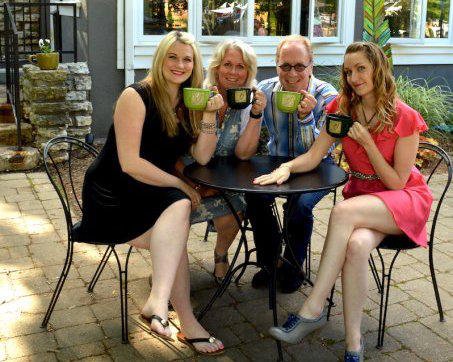
The family during a spring gather at the house of my sister-in-law.

Many years back, when I was still single and engaged in a long distance relationship with the woman I’d eventually marry, we ached to be together during the Thanksgiving holiday. She flew out to Philadelphia where I’d been sent on a job transfer and we made the best of it. I grabbed the literal last turkey in the grocery store and we baked it in the oven. Then we parted ways again until Christmas.

We’d only met the previous year in October. Any plan of being together long-term was just formulating. Early the next year, the company that moved me out East dumped the entire marketing department. I was left trying to decide what to do next. Stay out East, or move back to the Midwest?

I moved back to live with a friend in downtown Chicago and spent the next couple years living a dual life between the city and suburbs. That was a period of great change and experimentation. After a couple of years, I’d had enough of the Bohemian city life. We got engaged and married the following year.

During a summer vacation in Wisconsin.

From there, it felt like a blur of events as our first child came along, then another. We celebrated holidays with our respective families. Those days of celebration together rolled on. Mostly we got together at her family home where her parents were always wonderful hosts. Sometimes my parents would join those festivities. Over the years, we also invited friends to add to our joy.

Our Christmases were filled with family togetherness. The anticipation of opening presents with the kids was so high some years we had to let them open a small gift before the rest of the family got up so they wouldn’t burst from the pressure of expectation. Our kids were always respectful, but when they had a hint of the goodies to come, it was cruel to make them wait several hours to open the “big gift” that they’d requested.

Early on, one of those “big gifts” was the Red Ryder BB Gun from the movie A Christmas Story. It became a new tradition in the annual celebration along with watching the movie umpteen million times.

My son Evan Cudworth and my daughter Emily Cudworth/

My father-in-law loved those Christmas mornings more than anything on earth. He also made a big deal out of Easter joys and the annual Easter Egg hunts as well.

His birthday was on the Fourth of July, so that day was always filled grilling steaks and setting off backyard fireworks of the milder kind, except the year that his son and friends loaded up with a stash from across the border in Indiana and blew off so many fireworks the police showed up to confiscate many of them. When the cops arrived, my father salted away the major part of the fireworks stash in the garage. He was a conservative guy by trade, but he also loved a bit of fun. That’s how they did things out in the Nebraska hinterlands where he grew up. You had fun until you got caught. Most of the time, you still got away with it.

These days that father-in-law is gone. He passed away during leadup to Christmas 2012, the year before his daughter, my late wife, passed away after eight years of ovarian cancer treatments. These days, my mother-in-law is quite alive and doing well. But we’re cautious with our visits given the Covid-19 pandemic. My own mother and father passed away in 2005 and 2015, respectively.

So we’ll be apart this year on many fronts. My son lives in Venice, California and the state is rife with Coronavirus, so he’s sitting tight. I cancelled a planned visit with him earlier this year over concerns of infection myself. This will be his time in 34 years that he’s not in company with direct family during the Christmas holidays. It hurts to be apart. But there also comes a point in everyone’s life when circumstances or other interruptions place things out of our control. This is an inside joke with my children, but those changes really do “build character.”

My daughter and her boyfriend live nearby, and we’ll likely see each other. But they’re cautious about the Coronavirus too. Even more than I. So we’ll all Zoom with my sister-in-law and brother-in-law and make the best of this holiday the way we have always done. That’s what most families typically do during the holiday season anyway. We go through the motions of opening presents, but to our group’s credit over the years, we dialed that down quite a bit, choosing one person to “gift” each year, and we’d buy or make small themed things for the rest of the family. That took the pressure off the shopping. We could all focus on the joy of appreciation instead. I’m always grateful we did that. It was the right kind of pride to turn our attention away from the presents and toward the relationships.

Our holiday get-togethers were always mixed in with long naps from food comas and other indulgences. For many people, that’s a big part of being together. Letting everyone have their time and space. Sometimes, it’s the unchanging nature of the holidays that makes them special.
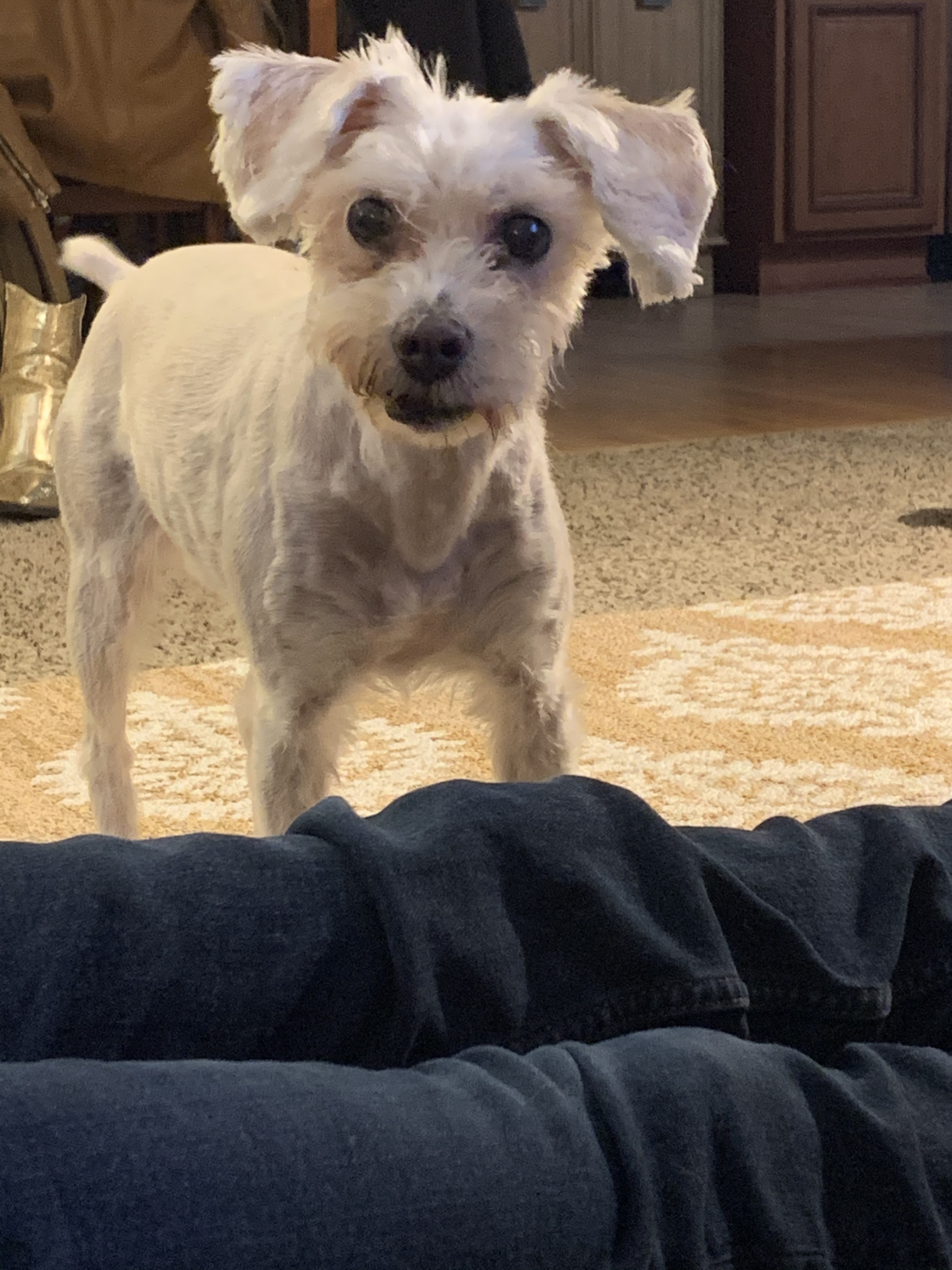
We’ve added some critters to our celebrations over the years. This little dog Chuck is a rescue that is now almost fourteen years old. My son has a dog named Luke Skybarker that he’s brought home from the holidays. This will be the second Christmas with our dog Lucy for my wife Sue and I. We’ve all adopted these pups and some cats because they bring change (and joy) into our lives each day.

It’s also true that life’s changes come along whether we like it or not. That’s why finding joy amid the changes in the moment is important. The ache of times past comes from the happy remembrance of shared celebrations. That is the inseparable bond from which we can draw strength. When our hearts ache from being apart, we turn to that. But there is also the joy of creating new traditions, celebrating with newfound connections as well. Over the years, we brought people into our circle to share those bonds. That’s a tradition we should all embrace. Make the world our family.

If this year has proven anything, it is that increasing the breadth of that “circle” is the reason we’re all here. Reach out. Make it happen. The world needs you. Celebrate Christmas or whatever you do by connecting in new ways and old. That’s what this is all about. Peace. And joy to you.

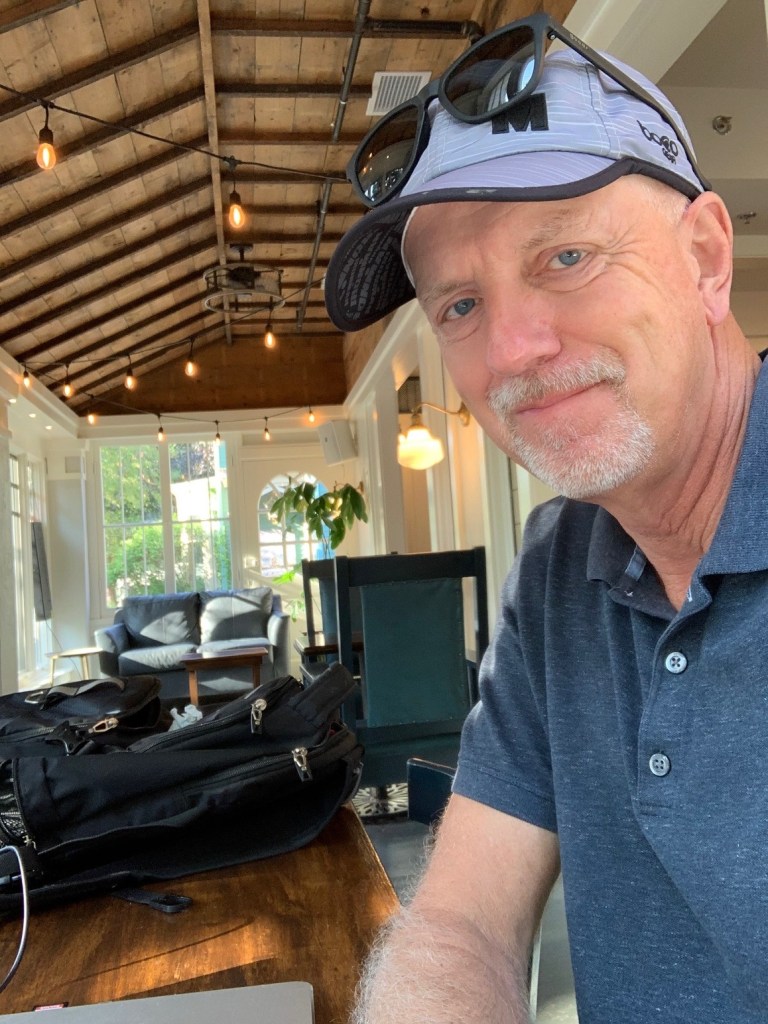
Take pride in that aging face

Originally published on my blog WeRunandRide.com

Posted on November 18, 2020 by Christopher Cudworth

Let’s talk about aging faces. I have no real way of knowing the age of the people who read this blog. There are about 1500 subscribers, and there are some who don’t subscribe but read these words through social media and other portals. But no matter what age you are, we all deal with the aging on our faces.

When you’re in your tweens and teens, those facial changes have profound impact on your self image. Getting zits and growing facial hair is a part of growing up. Dealing with tweezed eyebrows and the right makeup mix, or watching a callow jaw shift to manhood are all part of the process. Hair length also affects how facial changes are seen.

So the process of dealing with our aging faces starts early in life. Add in the impact of getting braces on your teeth, or in my case having a baseball accident smash a front tooth, and the changes never cease.

Those of us that compete in athletics put our faces through an entirely different kind of strain. The grimace lines wrought by the pain of endurance sports begins the process of forced aging that continues throughout our lives.

The effort shows in our faces.

So perhaps it’s time for all of us to take a healthier form of pride in that aging face we see in the mirror each day. That face of yours has so much to tell about all what you’ve gone through. There is laughter, joy and excitement. There is sorrow, fear and depression. All in the same face. It’s a wonder we don’t wear them out with all these emotions.

In recent years, I’ve worried that the look of my face has begun to limit opportunities in life. The ugly specter or ageism creeps up on you secretly. People aren’t going to tell you to your face that they consider you “too old” to do a job or fit into a workplace culture, but it happens. By law, age discriminate is illegal. Yet we all know that it still happens.

Wattled and tired

I was sickened one day while reading an article that popped up in my social media feed. A younger writer crowed that he wants nothing to do with people whose faces are “wattled.” That’s a disqualifying factor in his mind. His thinking seemed to be centered around the idea that if someone looks old, they must be unable to think clearly or creatively.

That would be news to millions of people throughout history whose contributions to this world continued or even began in their later years. I think in particular about the life of R. Buckminster Fuller, one of the most creative yet practical individuals to ever live. One of my favorite quotes by Mr. Fuller evolved from an experience of great sorrow and near defeat in his life. He’d experienced a great personal tragedy and was depressed beyond imagination. He indulged in a period of intensive personal isolation to figure out what to do next and emerged with a vision of new purpose, “You do not belong to you. You belong to the universe.
He used that perspective to face the world in a new way. Among his many inventions were the geodesic dome, a mathematical breakthrough in architecture. His influence and thinking continue to expand to this day. No one cared that he looked young or old. What matters is how he thought. We all need to grab that truth and never let it go.

We should also never forget that our faces are attached to our bodies. Today I read an interesting article in the Chicago Tribune about the fact that people who do something more than walking in their exercise routines wind up having better efficiency and posture as they age. While walking is beneficial, it doesn’t stress the body in the same way that cycling, running or swimming do. It’s the classic training principle that applies to life itself: you have to push past your boundaries to gain the most benefit.

That seems to be the principle at work when we consider the condition of our faces as we age. If you’re engaged and passionate and pushing yourself to continue learning and trying new things, it shows in your expression and even the condition of your face.

Facing life

Until a few years ago, I’d never heard the term ‘resting bitch face’ applied to the baseline expression of someone who looks dour or unhappy all the time. Is that term as bad as dissing someone through ageism? It certainly seems cruel. Yet there is a reality at work in how we project our emotions through our visage. I’m perpetually aware of the value of smiling during conversations with people.

That’s especially true in business situations. I once had a boss tell me, “I like you a lot more when you’re smiling.” He was right. I wasn’t a happy person during that period. My late wife had just experienced a recurrence of cancer and had a nervous breakdown as a result. I was scared, felt alone, and had little tolerance for the daily vicissitudes of business, which seemed so insignificant compared to what was going on at home.

Those internal conflicts showed in my face. There was little I could do about it at the time. Just put on the best face I could, and get through it.

Facial control

So we perhaps don’t always have control of what our faces say about us. There’s always the possibility that a person with a ‘resting bitch face’ has gone through so much in life their face reflects that path. But then again, some people develop attitudes of victimhood and duress that dominate their existence. There is such a thing as becoming so bitter about life that it shows in everything you do.

I’ve got enough life experience now to look back and understand the causes of the challenges I’ve faced in life, and the reasons for the mistakes I’ve made. I’ve come to realize that a native anxiety affected many of my decisions. So did a likely associative form of ADD, a lifelong challenge that often determined the manner in which I processed information, or did not. In summary, I’m proud of having dealt with these challenges and adapted to succeed in some ways along the way. It all comes with knowing yourself well enough to accept past mistakes and not let them rule the present.

I can look at my face in the mirror now and see all sorts of experiences etched there. I see miles of training and racing, and the self-belief emerges from all those tests. But they keep coming. A former coach once told me, upon hearing that my late wife was diagnosed with cancer back in 2005, “Your whole life has been a preparation for this.”

He was quite right. That coach later faced cancer himself. He passed away a few years ago. The thing I remember most of all about him is still his face. I don’t see him as young or old. There’s a spiritual aspect to that, I believe. Take pride in that aging face, no matter what age you are.

Tests of character

When I published a memoir titled The Right Kind of Pride in 2014, my goal was twofold: to write about the journey that my late wife and I shared through cancer survivorship, and to share some of the things we learned along the way.

Eight years of dealing with the physical and psychological effects of medical treatments, surgeries, chemotherapy and its side effects is enough to test the mettle of anyone. Toss in the emotional components of dealing with medical scheduling and recovery, insurance premiums and bills, financial changes and losses, and the whole thing gets overwhelming in a hurry.

During those years of dealing with cancer and remission, work and family challenges, I kept sensing that there was a message in it all.

That’s the other reason I wrote The Right Kind of Pride. I learned that taking care of business in the face of a crisis comes down to three critical components. These are:

Character: the mental and moral qualities distinctive to an individual.

Caregiving: the activity or profession of regularly looking after a child or a sick, elderly, or disabled person.

Community: a group of people living in the same place or having a particular characteristic in common.

To address how understanding these three factors helps one through a crisis, we’ll begin with the subject of character, and what that means to each individual.

Character is not a fixed trait

We often view “character” as a fixed quality in a person. But people respond to crisis in different ways. Some grow resolute, facing whatever comes their way with what seems like determination and courage. Others appear frightened or worried at the onset of bad news. There is no real predicting how someone will react to a crisis. Sometimes a seemingly strong person reacts with fear. At other times a seemingly timid person responds with great strength.

Character can even shift with age. Many character traits are subject to change over the years, especially as stress or life changes affect the emotional bottom line. Character can even radically shift within minutes if shocking new arrives. The death of a parent, a spouse or a friend. The birth of a child. All sorts of events, good and bad, affect how character is held or expressed in a given person.

That’s why it is important to understand the nature of “character,” and how to support it in yourself or the people around you.

Character tests

We might like to assume that character is the foundation that carries us through all kinds of tests. We speak of a person with “solid character” almost like they’re a piece of granite able to withstand all sorts of conditions. Yet if you’re in a position of helping another person get through a test of some sort, it is vital not to assume how they’re feeling, or even trust what they’re telling you at times. Most people don’t like to show or share their fears.

That is why it is important to be patient when it comes to placing expectations on others during times of crisis. Some want to avoid attention or engage in denial, wishing it would all go away. Others want to tell the world what’s going on in their lives, as if that alone could cure the problem. Most of us fall somewhere in between or run from one end of the spectrum to another.

Out of character

If someone responds in a way that seems “out of character” for them, it is clear they are trying to process whatever news or stress they are experiencing. Even good news can be a source of stress to a cancer or heart patient used to hearing nothing but frightening words about their condition. It is hard to trust good news because we don’t like to let our guard down in case something bad is about to happen again.

That puts us into a state of mind where character, “the mental and moral qualities distinctive to an individual,” needs to be considered a tool for monitoring the emotional health of anyone facing a crisis. There really is no such thing as behaving “out of character” when we think about it. No one on this earth possesses a permanently rigid nature. Nor should we.

It is what it is

Obviously it’s desirable to stand strong and deal with necessary actions as they arrive. My late wife and I treated medical regimens with a brand of objectivity. We compartmentalized the cancer and its treatments by saying, “It is what it is.” In other words, let’s not fool ourselves or try to avoid medical advice that might be hard to hear, much less endure. But if you put that practical activity in its place, it is much easier to support the character or the person or person’s involved.

Being able to say “It is what it is” provides a clear focus on the most difficult aspect of life in the moment. That’s at least a degree of control, and knowing the truth and having a plan to follow takes pressure off the character of a person. Then the mental and emotional aspects can be addressed on their own terms.

Character on the line

The same holds true for many circumstances in life. A business or other venture has a “character” of its own. Applying these same principles; identifying the central challenge, categorizing the necessary response, and setting aside conflicting emotional, competitive or selfish aims to address problems is vital in facing life or business challenges. That is how to manage character as a rule.

Despite all our best efforts, there are often selfish aims at work behind the scenes of everyone involved in a crisis. Our primal instincts are to protect our own instincts. Fatigue and stress, fear and self-doubt all work to undermine our character when facing our own crisis or helping someone else face get through difficulties.

The important thing in understanding character is that it is the cumulative experience in a person’s life their character is built upon, including weak moments and strong. The key to supporting the character of an individual, a team or an organization is to identify common traits of belief, hope, determination and goals, then relate those back to the character of those involved.

Asking questions to gain answers

That means asking questions in order to gain answers about how people feel about their own character. These don’t need to be probing psychological ventures. A simple question such as “How are you feeling about this?” defines the person’s character in the moment. That’s what you need to know first. In what mental or emotional state are the people involved?

When I first found out that my wife had cancer all those years ago, a longtime friend and coach called me on the phone with a message of encouragement. “Your whole life is a preparation for this,” he told me.

That was his way of saying that I’d faced adversity before. Dealing with stress. Managing emotions. Setting near-term objectives. Reaching goals, however fluid they may be.

Every person on this planet has a foundation of their own from which to build and maintain character. Helping others do the same in times of crisis is one of the highest levels of compassionate behavior in the human sphere.

QUESTIONS TO ASK YOURSELF ABOUT CHARACTER.

  1. What are some of the most formative events in my life?
  2. When were some of the times I was required to respond to crisis?
  3. What do I consider some of my most important character traits?
  4. How do I measure ‘character’ in others?
  5. Why do I value character in myself and other people?

I’d be interested in hearing some of your responses to these questions and would like to post some (named anonymous, your choice) to this blog.

Send your answers to cudworthfix@gmail.com. Your answers if you choose will posted anonymously. We can all learn from each other if we share.

On apples and temptation

3 Now the serpent was more crafty than any of the wild animals the Lord God had made. He said to the woman, “Did God really say, ‘You must not eat from any tree in the garden’?”

The woman said to the serpent, “We may eat fruit from the trees in the garden, but God did say, ‘You must not eat fruit from the tree that is in the middle of the garden, and you must not touch it, or you will die.’”

“You will not certainly die,” the serpent said to the woman. “For God knows that when you eat from it your eyes will be opened, and you will be like God, knowing good and evil.”

You may recall the fateful verses cited above from the Book of Genesis. That last line in Genesis 3:3 is a tricky passage when it comes to understanding the nature of temptation. When the Serpent said to Eve “You will not certainly die,” it was not a lie. Not in the short term, anyway. In fact, Eve took went ahead and ate the fruit, and lived. So did Adam.

They were both now engaged in a conspiracy theory of sorts and would have to hide their nefarious deed from God. That didn’t happen, of course. We all know the outcome of that story. Adam and Eve were booted out of the Garden of Eden. God then informed them that by listening to the Serpent and breaking the unspoken vow of obedience, they had lost the gift of eternal life. “Now you really will die someday,” God warned them. Ooops.

This tale is so popular in religious tradition that the “fruit” in the Garden of Eden came to be represented by an apple. That fruit is a good choice. Everyone recognizes apples. Even the Apple computer symbol has a bite out of it, and that’s no lie.

Apples play a large role in both religious and scientific history. As the legend goes, Sir Isaac Newton was bonked on the head by an apple that led him to consider the nature of gravity. History.com explains that didn’t quite happen: “There’s no evidence to suggest the fruit actually landed on his head, but Newton’s observation caused him to ponder why apples always fall straight to the ground (rather than sideways or upward) and helped inspired him to eventually develop his law of universal gravitation.”

We know that gravity behaves fairly consistently here on earth. The same cannot be precisely said about the genetic direction taken by apples. The human race has coerced and cobbled apples into countless varieties. Each tastes and feels different to eat. Some are tart. Some are mild. Some are crisp. Others are soft. All apples grow on trees, yet even these vary by shape. People love to play games with genetics.

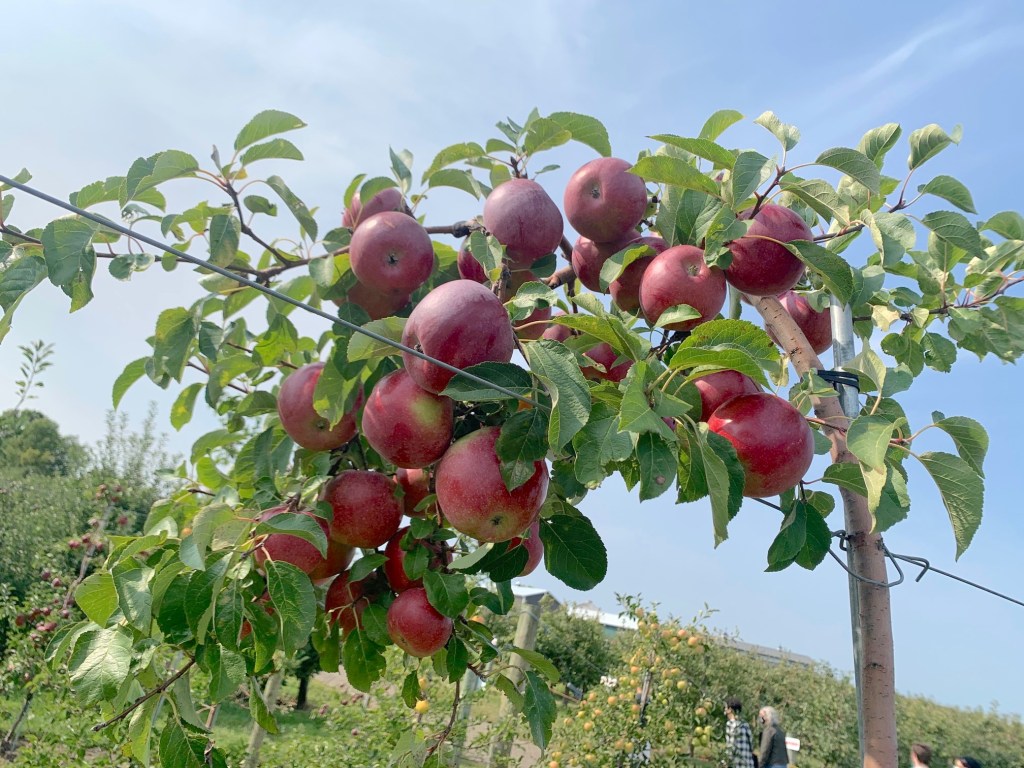
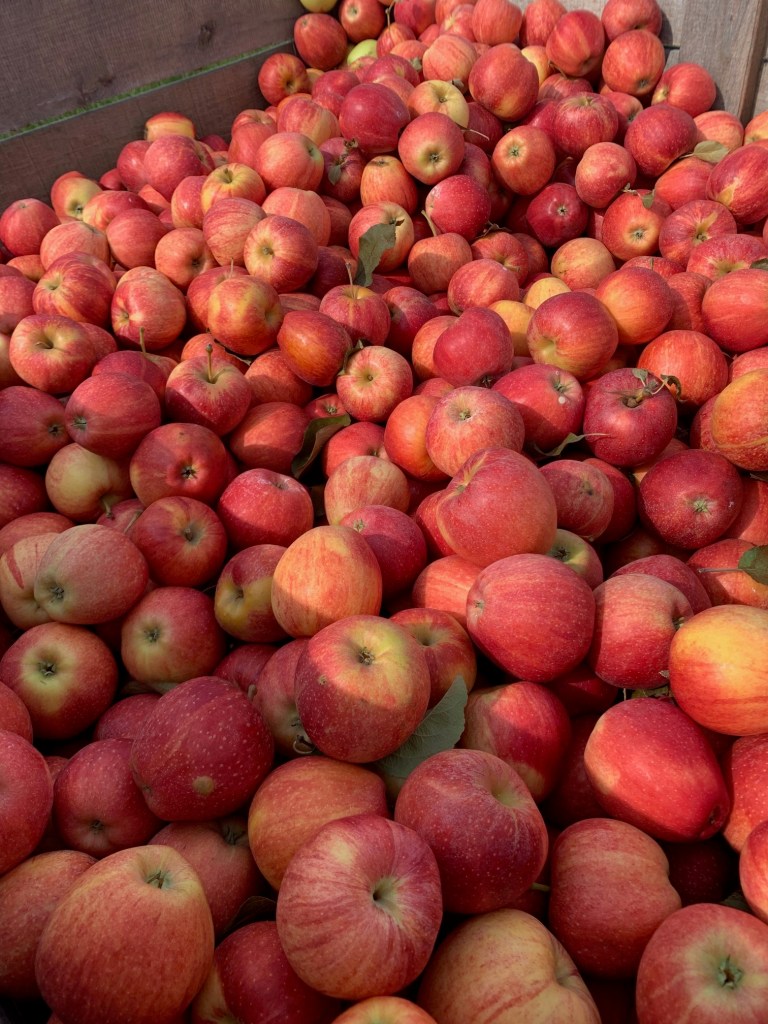
While apple-picking this past weekend it was obvious that people also like the hands-on experience of plucking apples from a tree. The organic quality of that experience recalls the act of temptation conducted by Eve and followed by Adam. A ripe-looking fruit of any kind is hard to resist. We filled our quarter-peck bags with apples of different sizes and shapes.

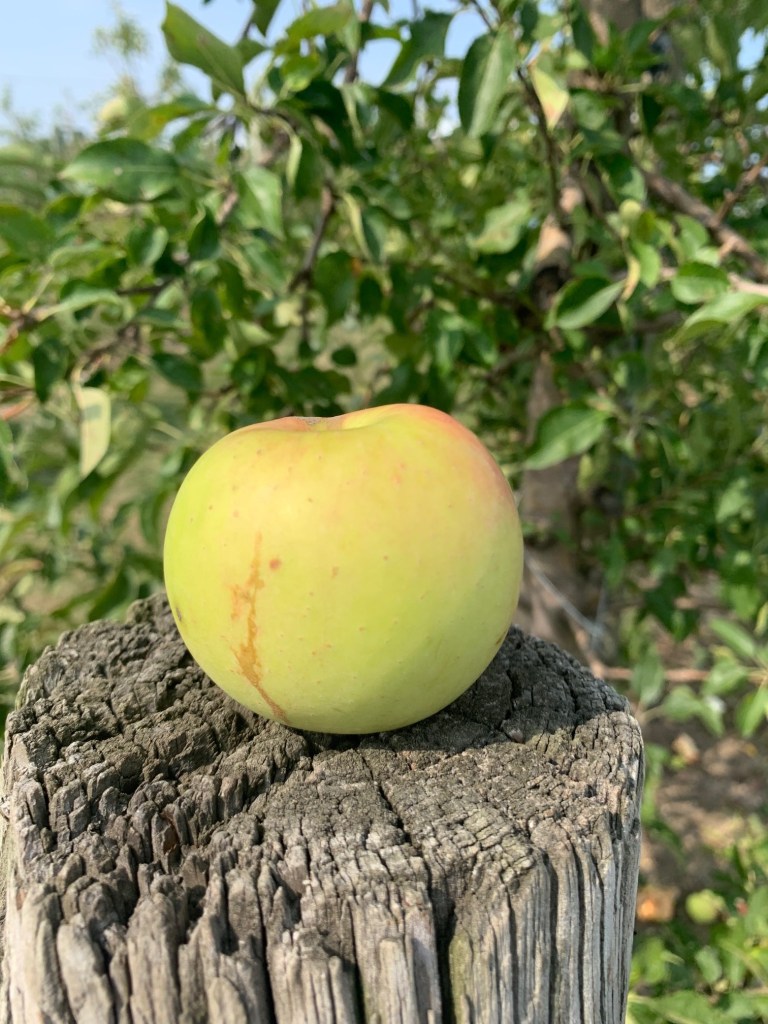
Along the way, we shared bites of different kinds of apples. There were Liberty and Empire, Honeycrisp and many others either ready for plucking or waiting a few weeks until they were in prime condition.

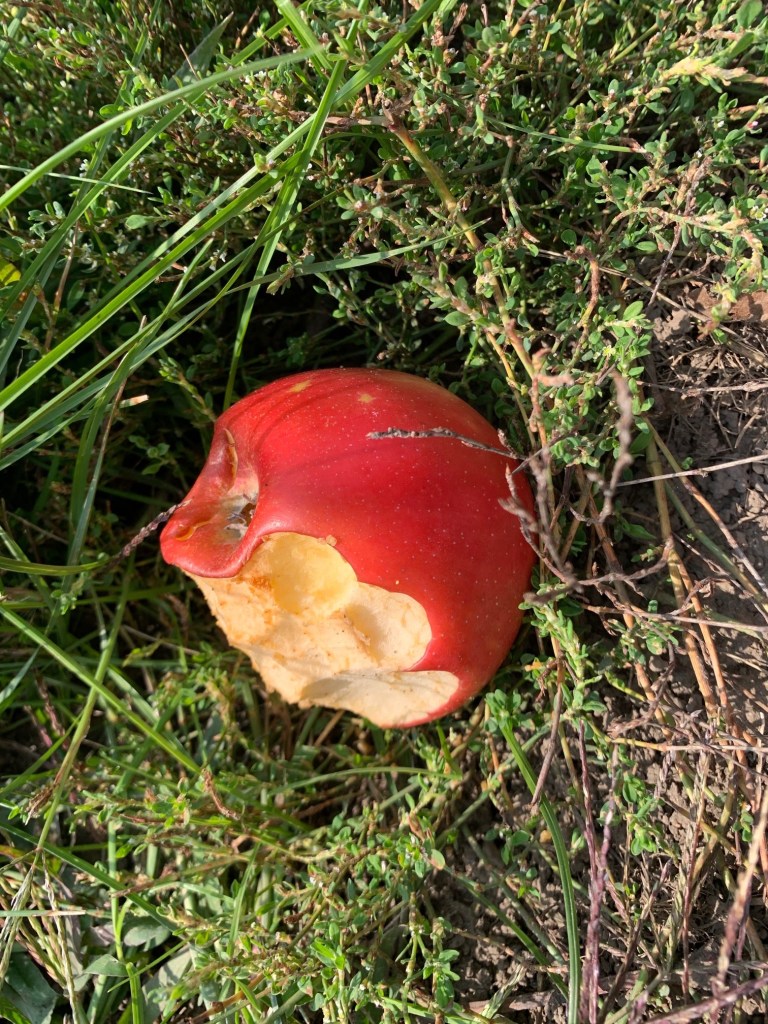
On the ground lay the detritus of apples either discarded with bites in them or recently fallen from the trees on their own. Some would be plucked up for use. Others would serve as fodder for yellow jackets.

The potential energy in every apple is hard to imagine. The evolutionary processes and human intelligence that combined to create these fruits would not be easily replicated if some tragic cataclysm befell the world’s population. The art and science of apple breeding is collective as much as it is individual.

Certainly there are growers out there who take great pride in the quality of their apples. The docent who talked us through the process of apple picking tried to educate the milling crowd about the best apples for baking and eating. It was a short talk. Civilization seems to have little time for learning. The apples sat out there like Forbidden Fruit. Let’s go have a taste.

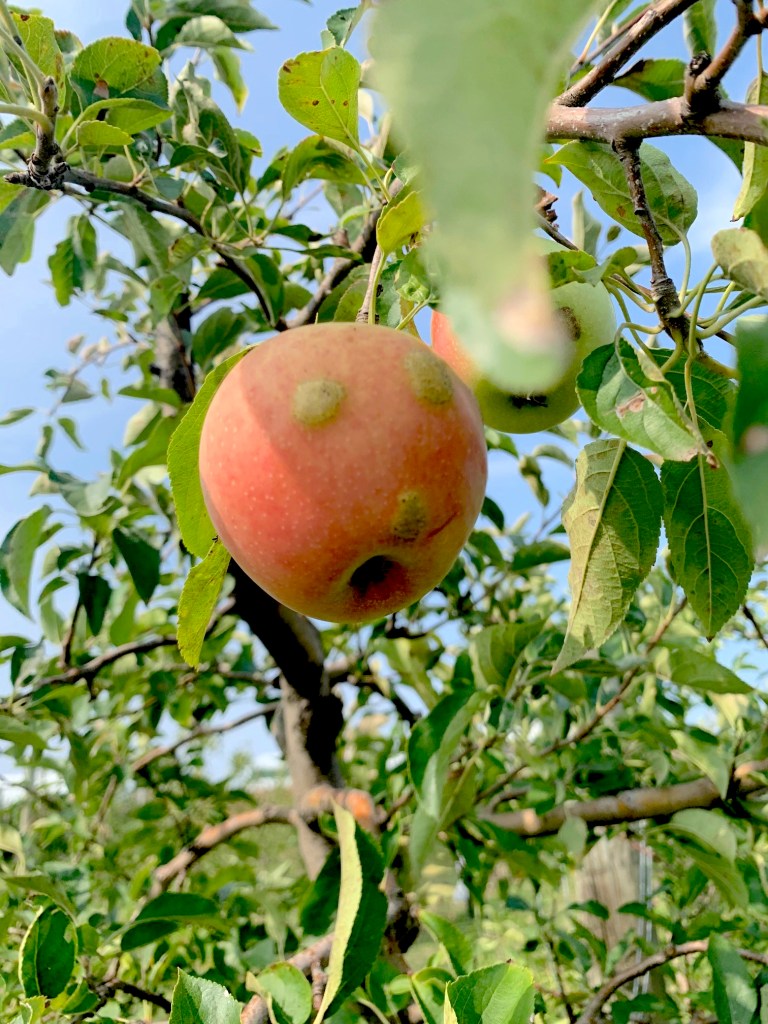
As we left, I discovered an apple on a tree that had a face on it. The mouth was agape as if it had just seen some distressing surprise. Someone said the fruit looked diseased. I picked it and put it in my quarter-peck bag just the same. It was coming home with me. That apple and I might share some time with a plate of peanut butter. We could talk about the birds and the bees, the sun in the orchard, and try to make some sense of why some people seem to believe in talking Serpents anyway.

I think it’s possible to wander through an orchard, a garden or a field full of goldenrod on a clear September day and realize that we can all look at the blue sky and see forever. We are alive in eternity. We can take pride in the fact that our human awareness enables us to consider the nature of our existence.

That brings us back to the meaning of the fruit in the Garden of Eden. Taking a bite out of that “apple” was not the whole story. The real sin in that situation was the Serpent claiming to own the authority of God and a shortcut to wisdom. That’s a warning against all others that would do the same. While tradition tells us it was the “Fall of Man” that took place in the Garden of Eden, in truth it was the Rise of Religion as one of the stumbling blocks between the human race and God.

That may sound shocking to some who hear it, especially to those who supposed that religion is the one gift from God that we can trust because it exists in close proximity with the Creator. That’s also not what scripture tells us.

Jesus learned that harsh lesson when Satan caught up with him in the wilderness. Just like the Serpent in Genesis, Satan offered food for comfort and all the authority in the world. Jesus wisely said no, showing that discernment is the right kind of pride even when the fruit looks so good you can almost taste it.

About dogs and cats and appreciation of kindness

Lucy the dog. She’s about 18 months old now.

We have a dog named Lucy adopted from a foster parent who got her from a non-profit called Safe Haven. That organization rescues abandoned dogs in states like Tennessee and brings them up to Illinois to find them homes.

Lucy is somewhat named after Lucy Charles, a triathlete that my wife Sue and I both admire. Her foster name was Bliss. We found that too hard to say.

She seems more like a Lucy anyway. Upon adoption, we received a breakdown of her breed background and it turned out to be 50% and a mix of border collie, boxer and beagle. She’s all that and more, as she’s willful and playful and silly all at once.

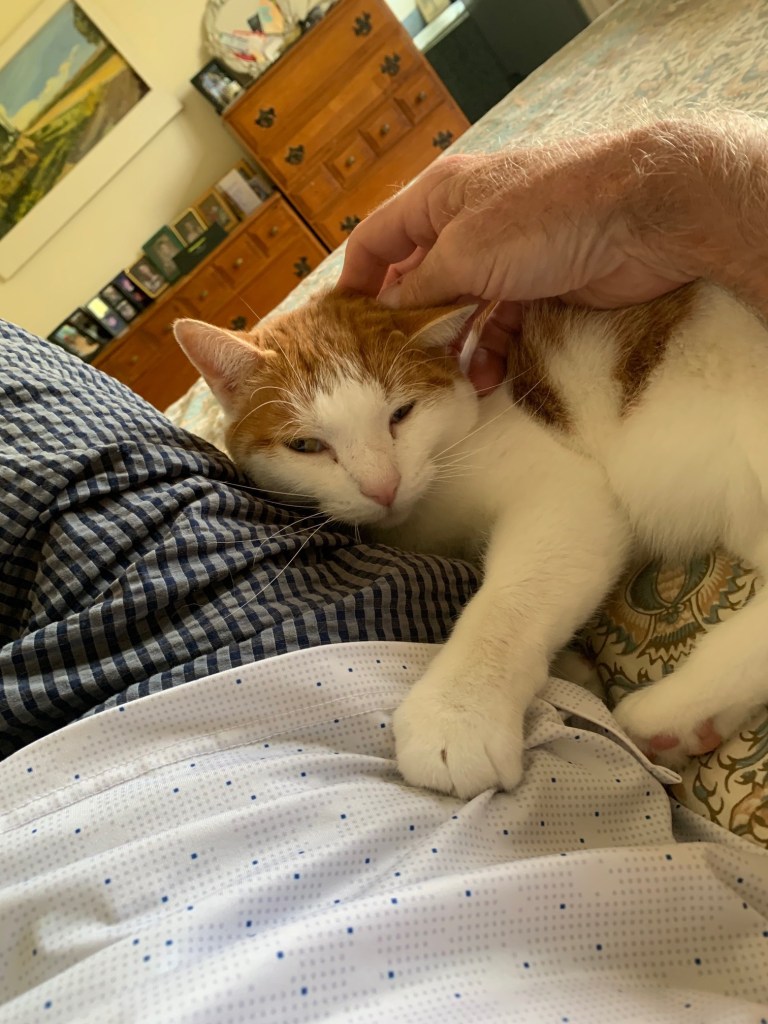
We’ve had her a year. It’s taken time, but she’s adapted to a nudging friendship with our cat named Bennie. He came to us from a vet friend who took him into the pet hospital after someone found him burned with a broken leg inside their car engine. He apparently climbed up there as a kitten to find warmth and got badly hurt.

Bennie the Cat. He’s five or six years old.

They called him Bernie (get the pun?) at the vet’s office but we changed it over to Bennie. He’s an orange and white charmer who escaped once and lived for ten days out in the neighborhood before Sue’s kids captured him down the block. He ate like a hog when fed that day and has never left the house since.

Lucy chases Bennie sometimes, but only in play, or when the cat sticks his nose into her food. Then Lucy charges to rid her bowl of cat cooties.

There are days when all this dog and cat caregiving get to me. I’d rather read the paper in peace some mornings than grab the leash, go out for a walk and wait for Lucy to pee or poop. Bennie, meanwhile, wakes us at 4:30 to be fed. I do the duty and go back to bed.

I was previously a dog dad to our family pet Chuck, the Schnoodle mix that my son saved from the streets of Chicago. That pupper is going on twelve years old now and lives with my daughter Emily.

But even these pups and kitties are not enough for me in this world. I ask permission to pet many a dog when I’m out and about. Sometimes the owners say, “They don’t usually like strangers. They don’t seem to mind you.”

That’s the biggest compliment one can get. To be something other than a threat in this world may be a small achievement in the scope of things. Yet if more people had the character to show kindness toward others we would all be better off for it.

Chuck the dog. He’s about twelve years old now.

The cats and dogs that need a home in this world are a testament to the difference between being kind and being a threat to others.

That is not to say that everyone should go out and adopt a dog or cat. But the number of abandoned animals left to fend for themselves, especially in certain states where the problem is rampant, is a clear indication that people are making raw and often selfish decisions about the value of life.

Then there are puppy mills where female dogs serve as breeding labs for commercially profitable pets. Some of those operations are run by people claiming to be almost holy in other aspects of their lives. It’s amazing what money ultimately does to the theology and ideology of so many people.

That harsh reality illustrates the dividing line between the selfish notions of what people expect from animals and what their grasp of humanity really is. I’ve heard many people say there is no gratitude like the loyalty of an animal who knows they were saved. I’ve seen that grace firsthand. Even on my most selfish days––and we all have a few––the only reminder I need to be kinder and more attentive that day is to look in the eyes of these cats and dogs. They teach us to appreciate all that we’ve got in this world.

“I’ve BEEN A WAITRESS SINCE THIRTEEN…”

One afternoon while heading out of the college cafeteria during the last semester of college, a classmate clearing plates and cups from the tables in the Union lost control with her hands and it all came crashing to the floor. That moment inspired a poem that I wrote based on how she responded.

WAITRESS SINCE THIRTEEN

Although the saucer fit the dish, she turned too quickly, threw the cup,

and watched in vain as coffee stained her shoes and left her morning drained,

“You’d never know,” she said to me, “I’ve been a waitress since thirteen.”

Last night I was writing at a local eatery and overheard the head waitress talking about her previous places of employment. Both are well-known restaurants. They’re not cheap places to dine. She talked about the fact that some of the clientele was snooty, and that the establishments charged way too much for what they provided. Now she’s happier working in the open bar and restaurant atmosphere where customers are more down to earth. She works the room with candor and kindness. An expert waitress in her element is a sight to behold.

Hands-on, hands off

Two weeks ago in Florida, we celebrated a landmark birthday with a relative at their golf club. Our round was delayed by rain and there was a wedding going on upstairs where the main bar and grill are located. So we moved to the downstairs bar and ordered food and drinks. Things were getting merry among the members that had already played that morning. Several were showing the effects of drinking.

The waitress working the room is a veteran of such situations. I watched her deftly fend off the handsy attentions of a member well into his liquor. She kept a smile on her face the whole time while using her arms like fencing swords to redirect his advances. In those situations a waitress is something far more than a person who serves food and drinks. She was at once counselor and therapist well-aware that there would be a tomorrow even if her customer refused to recognize it in the moment.

Frontline dedication

During this pandemic mess, we’ve all learned who the real frontline workers are. They are people at the point of contact for all sorts of human interactions. This morning the Chicago Tribune reported that here in Illinois, customers will be required to keep their masks on while ordering food. That’s a small move to protect the health of those who wait tables. Surely some people will take offense to that requirement as they have toward the concept of wearing masks at all. But they would be selfish and wrong to do so. Sadly, some will refuse to comply.

That further places our wait staff in positions where they are forced to govern all sorts of human behavior. Here in America, waiting tables is typically viewed as some sort of servitude. Not so in other parts of the world, where being a waiter or waitress, or however you care to describe it, is considered noble work. It takes real character to be a good wait staffer, whatever the circumstance. It is a form of caregiving in real time. Our sense of community in this world comes from such dedication. Wait staff are the frontlines of civility.

In-flight service

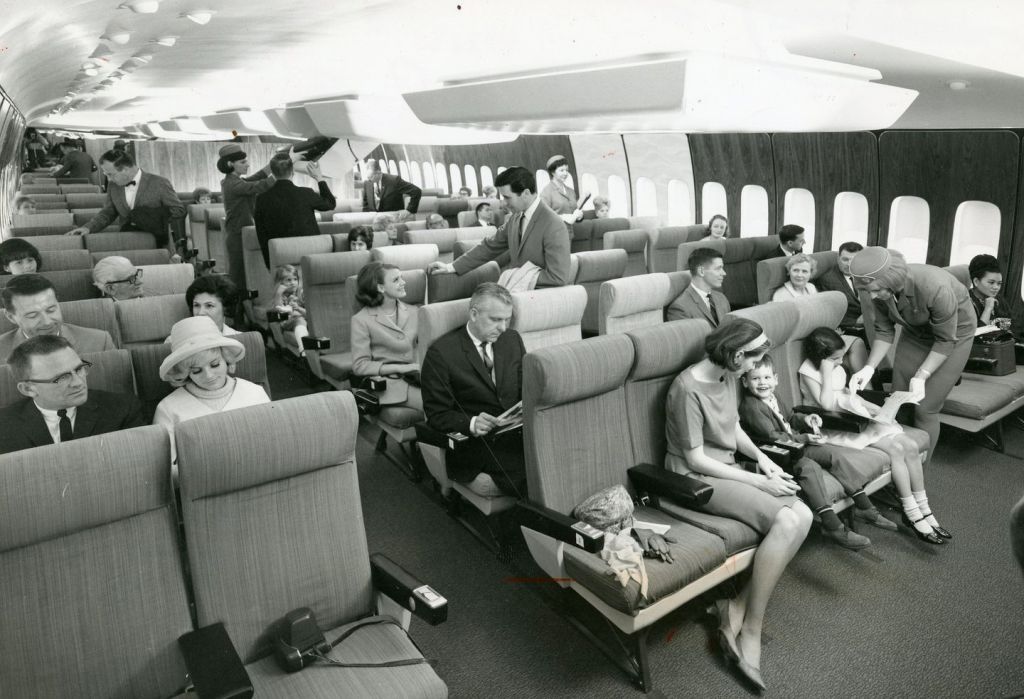
The same goes for the people working these days as flight attendants. That profession has changed drastically over the years. Where full meals used to be served on many flights, these days it is more common to receive a bag of salty snacks and a glass of ice water.

The old standards about appearance that once applied to flight attendants are now gone. Travelers also don’t fly in formal wear they way they once did. Airplanes are now packed wall-to-wall with people to maximize profits for every flight. That strategy has backfired in the age of the pandemic, and the middle seats now sit empty.

The entire industry is a bit more low-brow and some regret that loss of glamour. Flying moved from an experience to be enjoyed to a gut-level mode of transportation. Airplanes are no longer a version of a flying restaurant for shorter flights. The in-flight movies can be nice, and Wi-Fi is appreciated. But these are more about sharing isolation than engaging in the communal experience of air travel with flight attendants as hosts.

Noble work

It is still noble work taking care of others, despite what the prideful and selfish among us care to think about it. In a world where so many people behave grotesquely in public while looking down on others for their manner of earning a living, it is the right kind of pride to look for the humanity in all those doing their jobs. Because unless we all do that, the world is doomed to its caste-like appetite for tribalism, wrought with greed, dismissiveness and abuse.

So to make the point about treating others right in public, we’ll leave with this video from the Monty Python movie The Meaning of Life. The first time we watched this in the theater my brothers and I almost heaved up our popcorn while nearly dying from laughter. Absurdity is often the best illustrator of graphic abuse. There’s a little too much Mr. Creosote in the world right now. That’s not the right kind of pride.

Finding a way to make things work out

Over the past winter the coffeehouse where I often go to work and write was closed for a complete remodeling. They stationed a smaller store a block away while the expanded Graham’s 318 Coffeehouse was being constructed. But it was a test of patience and timing while the new store was being built. The City of Geneva is pretty picky about its appearances and historical feel, yet Graham’s and the builder Hogan Construction made it work.

Then when it finally opened, the Covid Crisis hit. That delayed things again. Now the business is operating at full function allowing for masks and social distancing.

It has always been a welcoming place. There are regulars who work here daily. During peak hours the bustling background of people coming in and out of the restaurant acts as white noise to a writer. They don’t play their music too loud or too soft. The vibe is one of community. They even serve Two Brothers beer along with their incredible menu of coffees, teas and food menu.

Long-time associates

I’ve known the owners Bob and Beckie Untiedt for perhaps 20 years. We were members of the same church. They led an exceptionally well-run Praise Band in which my son played bass and cello. Then my daughter followed suit playing violin, but she was never much of a fan of praise music with its repetitive chants and predictable key changes.

That didn’t stop me from joining the group later on as a rhythm guitarist. I’d grown up playing clarinet and participating in bell choir in elementary school. Come high school, I learned to play some guitar chords with a group of friends and even performed a few songs for our Key Club banquet. That went horribly. Following that, I let the instrument go for twenty-plus years until my daughter asked for a guitar and I started playing again.

Joining that Praise Band was a humbling experience. My brain does not memorize music well. Some of the chords I was asked to play were difficult for my knuckle-cracking fingers to accomplish. But Bob and Beckie were patient and encouraging. After a year or two of being in the group, they even urged me to perform a song I’d written. So we practiced and had a go at it. I recall singing somewhat tentatively in rehearsal that morning and Beckie was direct and real with me. “You’re going to have to sing clearer than that.”

That was the point, after all. The song was titled Flowering Tree In Spring, a piece I’d written from different aspects of my experience. Perhaps it was also a competitive attempt to write something better and less repetitious than the praise songs we played so often.

The first stanza lyrics introduced the metaphor:

Have you gazed in wonder at a flowering tree in spring?

no petals yet have fallen a perfect, holy thing. 

If life were just that simple, no rain or wind would blow

then we might be as perfect as a flowering tree, you know. 

The song came out really well. I think Bob and Beckie have always appreciated the idea of people trying new things. Their businesses of Graham’s Chocolates and 318 are a living example of that. As a result of their considerably novel approach to business, these businesses are lively fixtures in the communities they serve. They also provide work for dozens of employees of diverse backgrounds and needs.

Yet the thing that I appreciate most about them is the impish brand of honesty one finds in Bob and the earnest commitment to quality in Beckie. Their business was recognized by the Geneva Chamber for its contributions to the community.

Appreciation

The Untiedts (center) with daughters Jaynie and Maddie. Kane County Chronicle File Photo.

Bob’s impish side is not directly revealed. I well recall playing a song in Praise Band by the musical artist Bruce Cockburn. Whether intentional or not, that act was a bit of a thumb in the face of the conservatism of that church, whose pastors often preached against homosexuality. Cockburn is gay, and performing his song in that church was something that I relished whether it was a closeted protest on the part of Bob or not. It was for me. All I can say is that Bob often had a wry smile on his face the days we played that song. But then, Bob always has a wry smile on his face. That’s who he is.

Beckie is kind of the opposite type of person, with an open-faced honesty for which she is both apologetic and unapologetic. If that sounds contrary, so be it. She’s a person of strong faith, but no stuffed shirt either. I recall the night that she was singing when one of the cups of her underwire bra broke, sending a sharp bit of metal into her side. She let loose a surprised yip and then starting laughing along with her Praise Singer sisters while trying to push the whole contraption back into place.

Musical talents

It was always astounding to me to watch their respective musical talents in action. Bob could sit and play songs on the piano seemingly out of nowhere. He’d transcribe chords for all the instruments from one key to the next, and orchestrate the parts of bass, rhythm, drums, lead guitar and piano in real-time. I don’t think in musical terms like that, but I can keep rhythm with the best of them, and that was my role.

Beckie is possessed of one of the most beautiful, clear voices one can imagine. There were nights while playing the guitar in practice that I’d get distracted by her lead vocals. Along with the harmonies of the gals singing with her, one could not help but listen. But then, I’m always easily distracted. Still, I once broke script in rehearsal and told her that she had one of the most wonderful voices I’d ever heard. She was a bit taken aback. Perhaps it was a bit too laudatory. Yet if someone doesn’t express appreciation for the good things in life, events roll by and things like that never get said.

Eclipsed by circumstance

That is why I felt horrible a few years ago when I was invited back to play with the Praise Band and was given a lead part to play on the rhythm guitar and things got out of hand.

The main song I was asked to play was one of my favorites and it went well in rehearsals the week before the service. But the morning of the performance I was also scheduled to do a live painting in front of the church and things got a bit chaotic setting up the easel and floor coverings while also trying to get ready to play the guitar. It was so noisy around the front of the church I went out to the narthex at the last minute to tune my instrument. On the way, I accidentally bumped the settings on tuner and changed the readings of the pitch. Not knowing that had happened, I tuned my guitar to the wrong key and returned to the front of the church to begin the service.

To my horror, I knew within two bars that my guitar was badly out of sync with the rest of the band. The only option I knew was to stop playing. Actually I faked it a bit at first, strumming nothing, then looked at Bob with a guilty shrug and mouthed the words, “Out of tune.” There was no time to explain. He covered my parts with some creative piano playing but to this day I get a queasy feeling every time I think about that moment.

That made it tough to concentrate on the painting process as well. The flush of embarrassment was still on my neck and face when I stood up to begin the painting. There was pressure to complete the picture in the few minutes allotted for the performance. It came out okay, and people were gracious, but I knew it wasn’t my best effort. It was all a lesson about being present in the moment.

It was also a lesson that taking chances and trying new things comes with some risk. I’m pretty sure that Bob and Beckie know better than anyone else I know that not everything we try in this world comes out a success. The story behind the scenes of life and work is often chaotic and challenging. In the end, the public face we present is the product of both determination and patience in the face of adversity. Along the way, we hope to celebrate the joys as well as endure the failures. That is how our true character is formed and emerges.

That is the right kind of pride. Finding a way to make things work out despite the frustrations of life is what it’s all about.

people can generally get along great, if you let them

Our neighborhood is diverse in almost every manner of description. Race and ethnicity. Sexual orientation. Nationality. Occupation. The list goes on.

Everyone gets along great because we’ve all gotten to know each other. Even when turnover takes place, and people move on to other places, new residents are welcomed.

Humanity on the block

We’ve held block parties every other year or so. These are informal occasions. Yet one year, a woman on our block who is one of the leading Latina marketers in the country brought a Mexican Senator to visit with us in our ring of lawn chairs at the end of the street. The Senator was in town to speak at a Mexican Independence Day event, the first woman to ever do so. Yet she confided in us that it was nice to be able to relax in a less pressured-filled situation, and just talk.

Someone suggested that we go around the circle that day and share a personal insight about gratitude. It was fascinating to hear the diversity in scope of those telling their stories. Then one of the families in attendance shared that they were glad to be alive. Only a few months before they had been in a dangerous car accident resulting in profound personal and emotional injuries. None of us had heard about that.

We all have challenges

That testimony illustrates that while we can all know each other casually and as neighbors, many times there are events and issues that we don’t necessarily share on a day-to-day basis. Yet the challenges we don’t share are often the most compelling parts of our existence.

We all sat stunned upon hearing the seriousness of the accident. Then someone quietly said, “We’re so glad you’re okay.” Yet the physical therapy continued, and the emotional strain too.

These are the feelings that connect us as human beings. While some shared quiet joys or happy accomplishments, others mentioned gratitude for having a trusted companion, or children, or a job that supports their household.

I don’t recall what I actually said about gratitude. But one of the feelings I had during that session was gratefulness for being around such an interesting and obviously compassionate group of other human beings.

Ethnicities are only the beginning of humanity

That brings us to the socially fabricated aspect of our neighborhood. Our ethnicities. According to traditional categorizations, there are four black families, three Latino families, an Asian household, several white or Caucasian families, a home with two women in a relationship, some elderly retirees and, of course, several dogs and cats that live in our cul de sac.

One of those families embraces several generation within the household. The head of that household is a leading law enforcement officer and former police chief of a Chicago suburb. But there are many variegations within the family, and attending one of their family parties means being introduced to visiting sisters, cousins, matriarchs and more.

Nacho diplomacy

One of the pre-teens who lives up the block loves to stop and talk with me now and then on our sidewalk. He’s got a curious mind and loves to test me with questions and topics of many kinds. Likewise, I like to ask him what he thinks about while riding his bike around, which he does all the time. Then one day he asked me, “Do you like nachos?”

For some reason that caught me off guard. “Yes, I do.”

He looked off in the distance for a moment and replied, “I love nachos.” So that became a bit of a joke between us. I’d drive by when they were out playing basketball in the neighbor’s drive and yell out, “Do you like nachos?”

I conspired with one of the same-aged neighbor girls to organize a “Nacho Day” when all the kids on the block were hanging around. She counted up ten children from the age of five through thirteen, and I called a local fast-food Mexican takeout and pre-ordered enough nachos for the whole group, who were waiting in the yard when I returned. Within minutes the entire stash was gone. I teased my friend again. “Did you even get any nachos?” I asked.

“Ohhhh, yeaaahhh,” he laughed while smacking his hands together on a basketball. Then it was back to playing pickup for him and the other kids.

Just let it happen

The kids on our block are a living example that friendship and trust and conviviality are all possible when people just let it happen. The same goes for the adults of all these different backgrounds who live in our neighborhood. It’s only when people are pushed apart by selfish interests and traditional fears that people don’t naturally get along.

The desire for control that stems from fear is the source of all racism. Yet it also drives other forms of prejudice as well. These lead to bigotry and authoritarian discrimination. Nothing splits up a society––or a neighborhood––or a country––like allowing selfish fears to depict people as “the other.”

Because rather than forming relationships around gratitude, compassion and shared aspects of humanity, such bigotry invests only in the “I’ve got mine and you can’t have it” aspect of existence. When that happens for reasons of tribal priorities, and these range from religious beliefs to racial identity to political or economic platitudes––civil society is at risk. Those priorities only lead to hate and division while the “live and let live” philosophy of a neighborhood sharing in commonality and humanity succeeds far better. That’s the right kind of pride.

People can generally learn to get along great, if you let them

I believe that everyone gets along great, if you let them. That may seem naive to say, but it’s proven so often and in so many parts of the world that despite all the conflict it is still true that people can learn to get along together when they aren’t told that other people are a threat.

Those that refuse to get along on those terms need to be held accountable for their selfish ways, and made to understand why that isn’t acceptable. They will often resist and brand themselves the “victims” of reverse discrimination or claim to be “persecuted” for being exposed for their bigotry. Those habits go all the way to the top in this world.

The self-inflicted will even attempt to turn around and call the compassionate among us inhumane, as if caring for other people and standing up for the meek or disadvantaged in this world was an act of oppression.

That is the gaslighting defense of those possessed of anger and fear who are eager to avoid facing their own inhumanity and the flaws it so often reveals. They refuse to accept vulnerability as a legitimate condition of human existence. These are the people that love to claim higher ground and preach unity while playing people against each other to create opportunities for control.

We should not let this happen. Not in our neighborhoods. Nor in our nations. People can generally get along great, if we let them.

20 true and funny golf stories in celebration of 40 years of caddyshack

My late father Stewart Cudworth was an avid golfer. He passed along that love of the sport to his four sons, but it didn’t quite stick. We all played golf plenty of times over the years, and I still do on occasion. But mostly, we had fun on the course.

Like millions of others in this world, my father also loved the movie Caddyshack, especially the Rodney Dangerfield character. My father was never one to admire false pride, but he did love a good one-liner. Hence the appreciation for Dangerfield.

I was always more fascinated by the Chevy Chase character, whose confused virtues included moments of incredible talent but also a bad case of the yips. That’s golf, for you. So here goes: 20 true and funny golf stories to which I was either a direct witness or a willing audience.

  1. My sales associates at a newspaper where I worked loved to play golf every week. One of them called himself the Polish Prince. He was a buff, athletic type with a chiseled face and a set of beefcake photos that he hoped to leverage into modeling contracts. We all loved to mess with him and tease him about his golf game. One day his golf ball rested on the green when I walked up to tend the stick, so I gently stepped on the ball to press it into the green. When he putted, it shot straight up in the air and struck him in the forehead. I couldn’t have hoped for a better result.
  2. A player from the investment banking firm where I worked in one of my first jobs out of college had a terrible slice with his driver. The ball would bend in an incredible arc and wind up two fairways over to the right. So I told him to aim far to the left and the ball would curl around and land on the right fairway. So he turned at 45 degree angle, swung madly at the ball and hit is as straight as could be. It traveled over two fairways before coming to rest in a woods.
  3. At that same investment firm, the company held a golf outing for its employees. We all stood around our carts at the first tee when the President of the firm walked up to hit the first shot of the day. Unlike many of the employees at that firm who had been college athletes, the Prez was not an avid golfer. He swung and the back of his driver struck the top of the ball, sending it careening into the parking lot behind him where it ricocheted off several cars. “And that’s why I don’t like golf,” he turned to everyone and said.
  4. While playing with a work associate at a local up-and-back golf course in Sycamore, Illinois, I watched him duckhook every drive with incredible force. He’d been a Big Ten athlete and was powerful. On the fifth hole another player was standing next to our fairway because his shot had slid through the trees and wound up on our hole. My associate didn’t notice him and went ahead with his drive. The ball curved almost out of bounds to the right before curling back to strike the player facing us right in the collarbone. We hustled up to meet him on the cart and apologize. All he said was, “Well, you didn’t get much roll out of that one.”
  5. I was playing well on a course named Settlers Hill, a layout built on top of a landfill in Geneva, Illinois, when I hit a long drive on a par five and found my next shot resting on a downhill with a clear view of the green. Eager to put it near the cup with a chance for an eagle, I swung fast and hit the ground a full foot behind the ball. Frustrated at losing that shot to bad form, I swung again and hit even further behind the ball. My brother was standing in front of me watching the whole time. His retort: “Are you goin’ into farming?”
  6. While not strictly a story about playing golf, I spent many years doing running workouts on various golf courses. One evening at twilight I was doing interval training on a course and ran straight into a long rope held up by stakes to keep carts from entering a soft part of the course. The rope hit me at thigh length and flipped me into a somersault. I lay there stunned and bruised on the soft fairway, laughing at my stupidity.
  7. My college roommate related a story about a friend who came off the course during a club tournament perplexed by what a member of his foursome had told him when he asked what went wrong with his game during the round. “It’s your loft,” he was told. Wanting to know the details, the curious golfer approached his golf companion in the clubhouse and asked, “What do you mean by loft?” Without mercy, the guy told him, “Lack Of Fucking Talent.”
  8. Arriving at a golf outing late due to business appointments, I raced out to the assigned hole where our foursome was assigned to begin. When it came my turn to hit a drive, I sent the ball straight into the lake parallel to the fairway. Then another. And another. It took thirteen shots with penalties to finish the hole. Then I took a seven on the Par 3 to follow. Looking a 20 to start the day, I gathered my pride and got a par on the next hole. Waiting at the next tee, I stood back and bit and was approached by a guy that I knew was a serious golfer. He put a hand on my shoulder and said, “I give you credit. A lesser man would have lost it completely.”
  9. My former track and cross country coach loved golf and played quite frequently. But he also loved to drink on the course and decided one day to take the golf cart down a steeply inclined path at a breakneck speed. While he didn’t break his neck, he did separate a shoulder, collect quite a few bruises and have to quit the round that day.
  10. A college roommate and fellow cross country had a low handicap and had once placed in the state golf tournament in Iowa. We were playing a sweet little course in the hills north of Decorah, Iowa when one of his chip shots slipped off the back of the green and rolled down a hill onto a gravel path behind a stone wall. He pulled out his wedge and attempted to lift the ball off the path up on the green, but it caught the edge of the stone wall and ricocheted back to hit him the forehead. I tried not to laugh but even he tipped his cap back and said, “Will you look at that?” Nice red mark on his forehead.
  11. Nothing is more frustrating than losing a golf ball in open country and in plain sight. You drive your cart up to where the ball came to rest and…nothing. Looking around, you search the rough in case it’s hidden and still the ball is nowhere to be found. I was in that process when I peeked down the hole of a thirteen-lined ground squirrel to find my ball, personalized and all, perfectly wedged down the hole six inches below the ground. I took a drop. We didn’t bother trying to dig it out.
  12. Likewise, on that same golf course, I once lost a golf ball to a fox that ran out of the woods next to the course, snatched my ball in its teeth and ran back into the woods.
  13. I led a foursome on a charity golf outing and was happy to host some guests of a company that had sponsored a promotional program I developed. One of the players in their crew was the facilities construction manager for the restaurant chain. He quietly muttered to me, “I don’t play much.” And for the first eight holes he scattered shots everywhere, including one that soared into a neighborhood and struck a large plastic garbage can with a loud thud. “Come on,” he said, jumping in the cart. “Let’s get out of here.” The final hole of the front nine was a long carry over water to a par three elevated green. Before his drive, he settled in behind the ball, bent over to address it and said, “Hold your breath.” And sure enough, that shot went straight into the water with a giant splash.
  14. My father and I once participated in an outing to raise money for Special Olympics. We were partnered with a professional golfer named Charlie Rymer. A humorous Georgia boy, he had a comment for almost situation on the course. Went my father took a long divot out of a nice fairway, Charlie grinned while picking it up to hand it to my father. “Keep that thing. That’s a salad in California.”
  15. My brothers and I were extremely competitive on the course. Often our scores were quite close all the way through the round. Which is why my oldest brother was disgusted when I struck a six iron from 165 yards out, watched it land far to the left of the green, bounce off a sprinkler head and roll straight into cup for an eagle.
  16. Luck plays a huge role in golf on many occasions. I was playing with my father one Sunday afternoon and with two holes to go, I was losing to him by a couple strokes. From thirty yards out from the green, I chipped a wedge and it came in high and tight, landing directly in the cup where it bobbled around with a funny sound. “Holy crap!” my father chortled. The next hole I chipped in again for a second straight eagle. It was the only time I ever beat my father in a game of golf.
  17. Facing a water hole is always a golfer’s psychological challenge. More than once, I’ve watched terrible shots go low off the club and skim across the surface of a lake to wind up on the fairway or better yet, safely on the green. If one does not thank the Golf Gods after such a stroke of luck, it is certain that karma will catch up to you that same round.
  18. While playing a round of golf at a local resort, I was paired with a guy whose drives were notoriously short off the tee. I kept forgetting that he rarely hit the ball past 120 yards, and kept zipping past his ball on the cart. The problem only got worse as the day grew warm and I was concentrating hard on my own game. On the thirteenth hole or so, he turned to me as we zoomed past his ball and said, a little less patiently, “Turn around!” Without thinking, I spun the steering wheel to the left and he flew through the air off the right side of the cart. In mid-air, he called out, “You should have told me!”
  19. Cheating at golf isn’t that funny. But it can be darkly funny when everyone in the foursome realizes the tactics of a dishonest player. The Publisher of the newspaper where I worked in the early 90s was so proud and competitive toward his employees that he was always using a foot wedge to improve his lie or rescue an errant shot stuck behind a tree or fencepost. Then he’d claim a par or a mere bogey on a hole where we counted his strokes plus the penalties and knew he’d gotten an eight or a nine. But we learned to laugh at his secretive little antics and let him “win” because we all valued our jobs. But man, did we make fun of him behind his back.
  20. For some people, the pressures of the game are simply too much. They go into fits of rage, throwing clubs or cursing and swearing. One pro golfer famously (reportedly) threw his entire set of clubs into a water hazard after a terrible round. Marching toward the clubhouse, he suddenly stopped, turned around and waded down into the water to pull his bag out of the water. Then he removed his car keys, tossed the clubs back in the drink and left in a state of humbled rage. True or not, that’s one of the best and funniest golf stories I’ve ever heard.

Indeed, golf is a test of pride and purpose in this world. But learning to laugh at ourselves (and others sometimes) is one of its many lessons. Hope you enjoyed these (mostly) true golf stories. And don’t be too proud if you hit the links this summer. Humility is often the tool of better scores. Take a few less bold chances. Accept that penalty stroke. Chip of the woods rather than trying to hit through them. And don’t drive your golf carts on the greens. Only feckless Presidents do stuff like that. And it’s not funny.

Why the world makes it so hard to be kind

Recently Facebook sent a series of those “memory” notices documenting things I’ve said in the past on that platform. For the most part, I’m comfortable with my online presence over the last eleven years.

But some of it was not so good. The overposting. The arguments over politics and issues such as gun control, racism, religion and environmental issues. I get triggered easily because I care passionately about such topics.

At times I have become unkind.

Remorse and regret

I just wrote a piece on my blog about the Fine Art of Leaving Old Friends. It documents both the remorse and regret one feels in finding out that someone you used to like and trust becomes someone you no longer admire.

That is one of those moments when you find yourself questioning your own character.

I know there are people out there who view me in less than a kind way, people whose viewpoints I’ve challenged or questioned. Some people take offense at that. In fact, almost everyone takes offense at that. Most people don’t like change, and especially refuse it from sources and forces outside their trusted sphere. When they additionally find out there are people they assumed were part of their sphere, and thought like they do, but don’t, the sense of betrayal feels extra keen.

Hard to be kind

That’s exactly what makes it so hard to be kind in this world. Even a mild question can turn into a major point of difference if it is misconstrued. I just had that happen on Linkedin this morning. A man made a comment directed to me that was meant to be complimentary and positive. But I misunderstood his intentions and responded in a defensive way.

So I communicated with him off the main feed and learned that his actual intentions were kind. I then apologized and even offered him a complimentary content strategy consultation if he so chooses. He thanked me for that and said that he might well take me up on that offer.

Asking forgiveness

Asking forgiveness in that circumstance was the right thing to do. Of course there are people online who actually do have malignant intentions with their comments. We call them trolls in some case, because they seem to pop up like angry little beasts when you least expect them. In many cases they are exceedingly unkind. Cruel even. Some turn out to be monsters indeed.

As a competitive person, I don’t like to give in to bullies like that. But on some occasions I’ve stood my ground and persisted in the most truthful responses I can manage. One of those exchanges lasted a full day with a guy that hated my “liberal” politics. By the time he’d made all his accusations and exhausted himself making arguments, he finally admitted that on many issues I had made good points. We both learned something along the way.

Write it down

When the world makes it hard to be kind, it is kind of hard to take the high ground. Abraham Lincoln once said that the best thing to do when angry is to write all your worst thoughts in a letter, then crumple it up and throw it away.

It’s hard to crumple a nasty response on the Internet, but the Discard button works just as well. I try to use it as often as possible, lest some of those memories come up ten years from now, if Facebook and I are still around.

Or try a weird trick and write something kind in place of something nasty. “Kill them with kindness,” the saying goes. It does funny things to your brain, I promise you that.